In today’s rapidly evolving global electronic music and entertainment landscape, the DJ booth has long outgrown its traditional role as a mere backstage utility table. Driven by a global shift toward crowd-centric, 360-degree stage designs, alongside the explosion of cutting-edge tech like real-time stems mixing and cloud-based streaming, the modern DJ booth has officially transformed into a highly digitized, interactive, and immersive centerpiece.
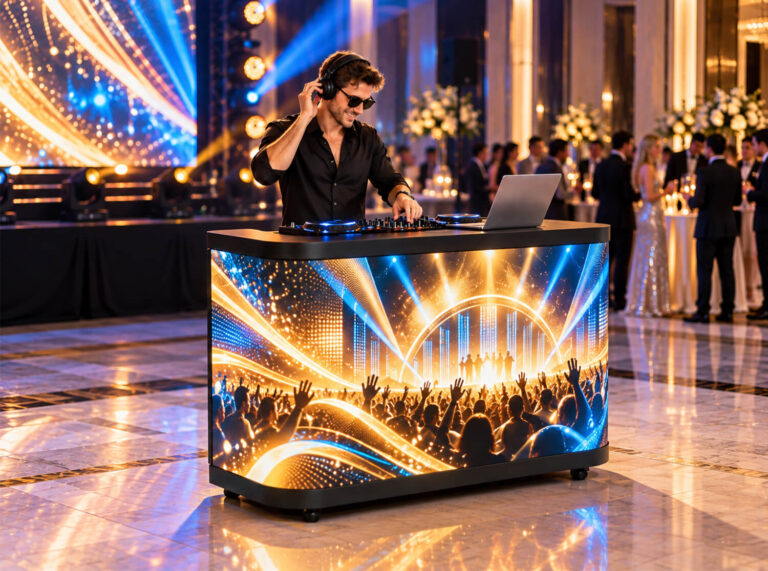
At the absolute forefront of this evolution is the meteoric rise of the LED DJ Booth. Modern nightclubs, festivals, and mobile event organizers are no longer just looking for sound support— demand seamless, real-time audio-visual synergy. This has turned modular LED DJ booths, equipped with high-definition display panels and advanced cable management, into the ultimate tool for amplifying brand visual identity and bridging the gap between the DJ and the dancefloor.
As a dedicated premium DJ booth supplier, we have witnessed this architectural revolution firsthand. To help you make a future-proof investment for your venue or production, this blog will dive into the main types of modern DJ booths and trace their incredible evolution from simple wooden decks to today’s intelligent, LED-driven visual hubs.
What Is a DJ Booth?
A DJ booth is a workstation designed to support and organize DJ equipment. It may hold turntables, media players, mixers, controllers, laptops, microphones and power equipment.
A professional booth usually serves several functions at the same time. It creates a suitable working height, hides cables, protects equipment and gives the DJ a defined performance area. Some modern designs also include lighting, television mounts or LED video displays.
The word “booth” does not necessarily mean a fully enclosed structure. It can describe anything from an open equipment stand to a large permanent console inside a nightclub.
A Brief History of the DJ Booth
1. Early Era: Fixed Furniture Booths (1970s–1980s)
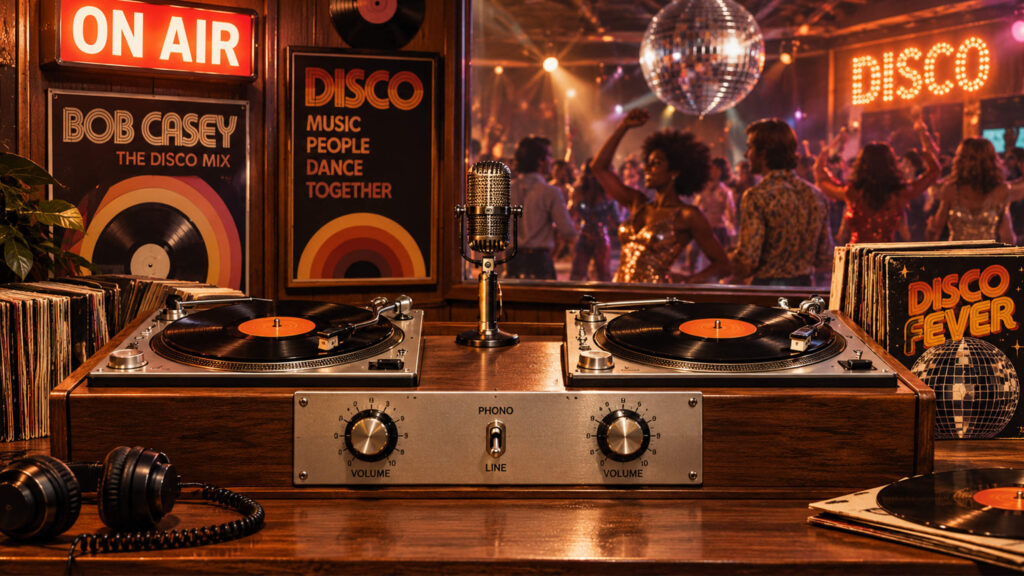
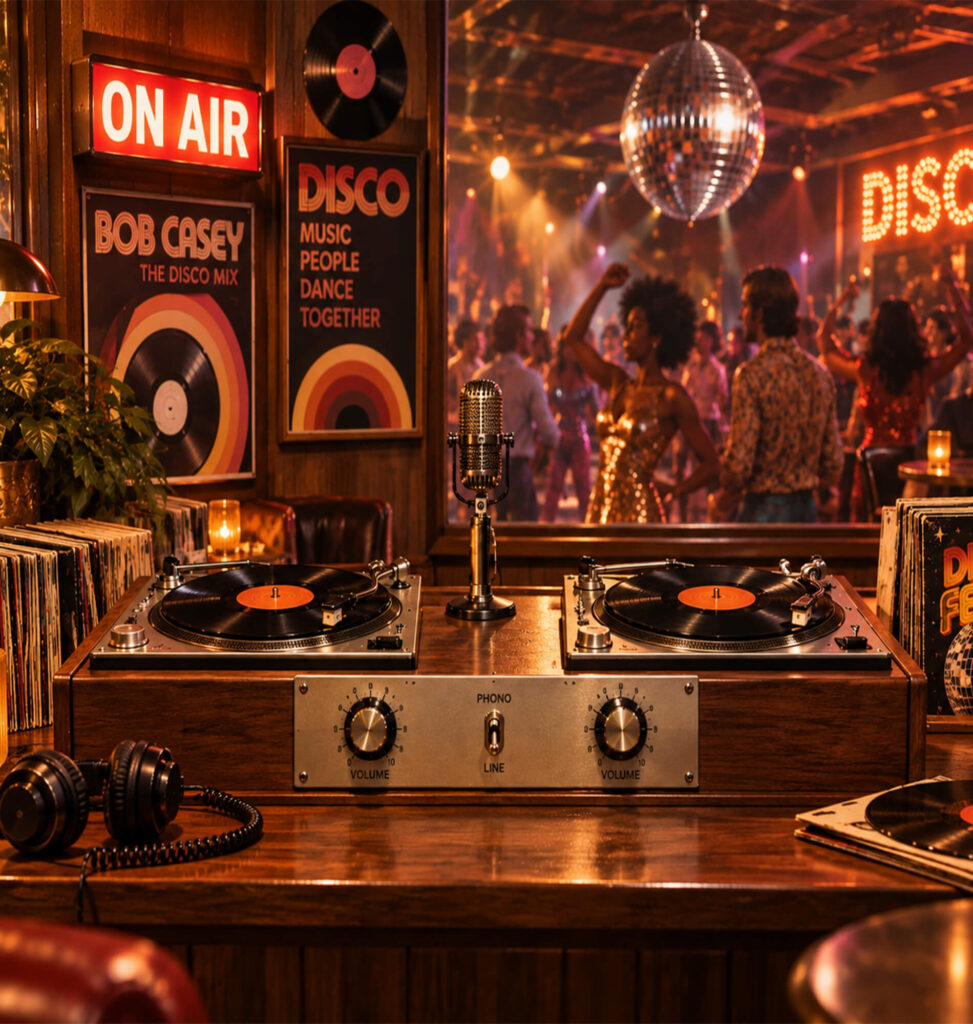
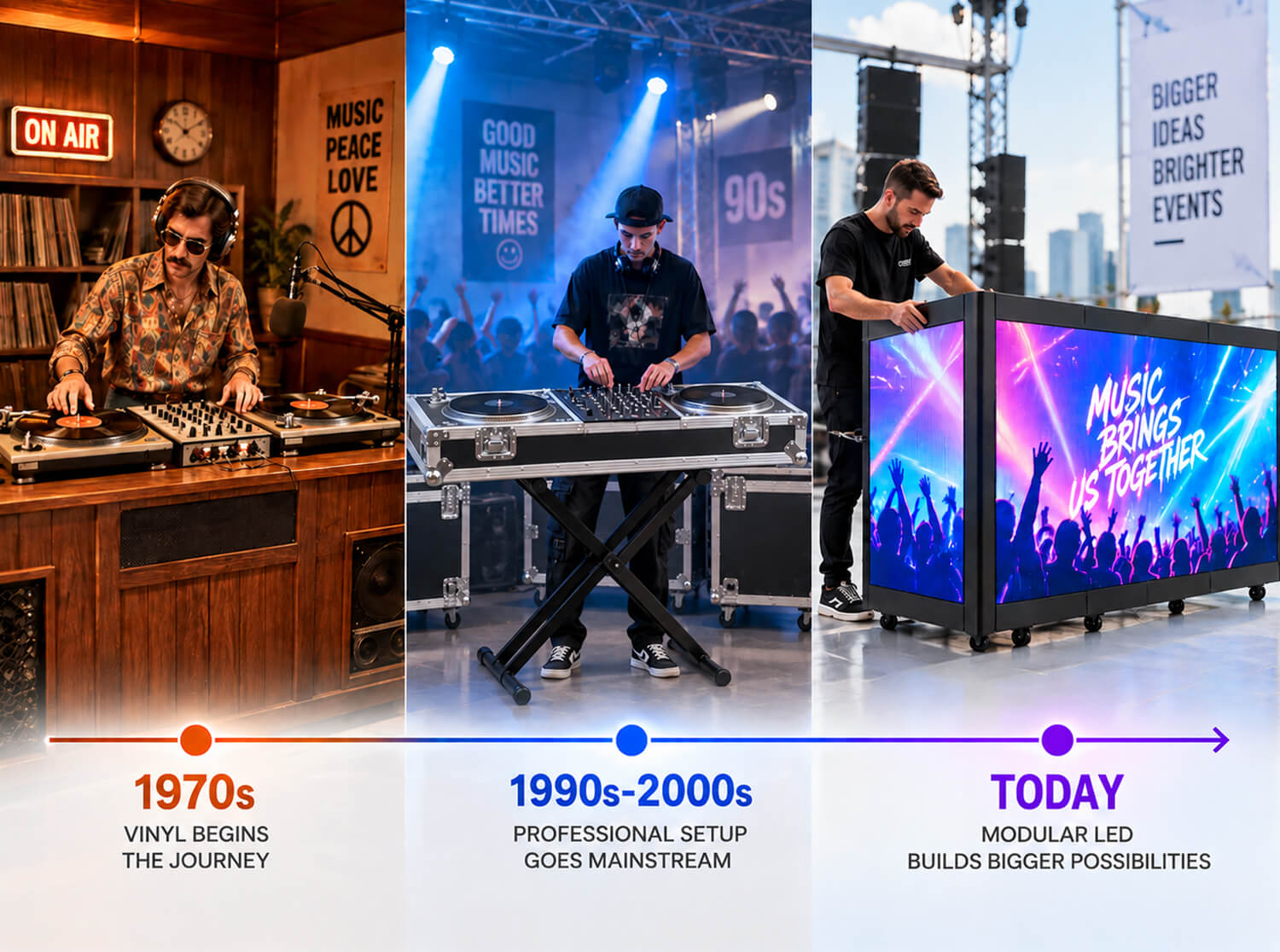
The earliest DJ booths weren’t really “booths” at all — they were built-in furniture, custom-carpentered into the layout of a nightclub alongside the bar and the sound system. These structures were permanent by design: heavy wood cabinetry, hardwired power and cabling, and zero expectation that the DJ setup would ever need to relocate. This era’s booths prioritized durability and integration with the venue over anything resembling portability, which made sense in a landscape where DJs mostly worked one resident club rather than traveling between events.
2. Mobile DJ Era: Flight Case and Rack Booths (1990s–2000s)
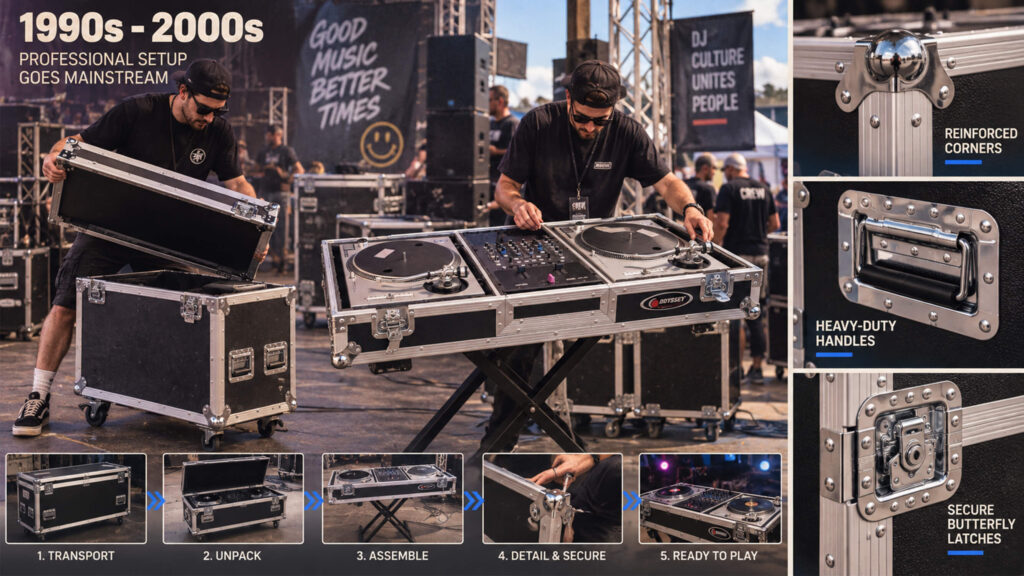
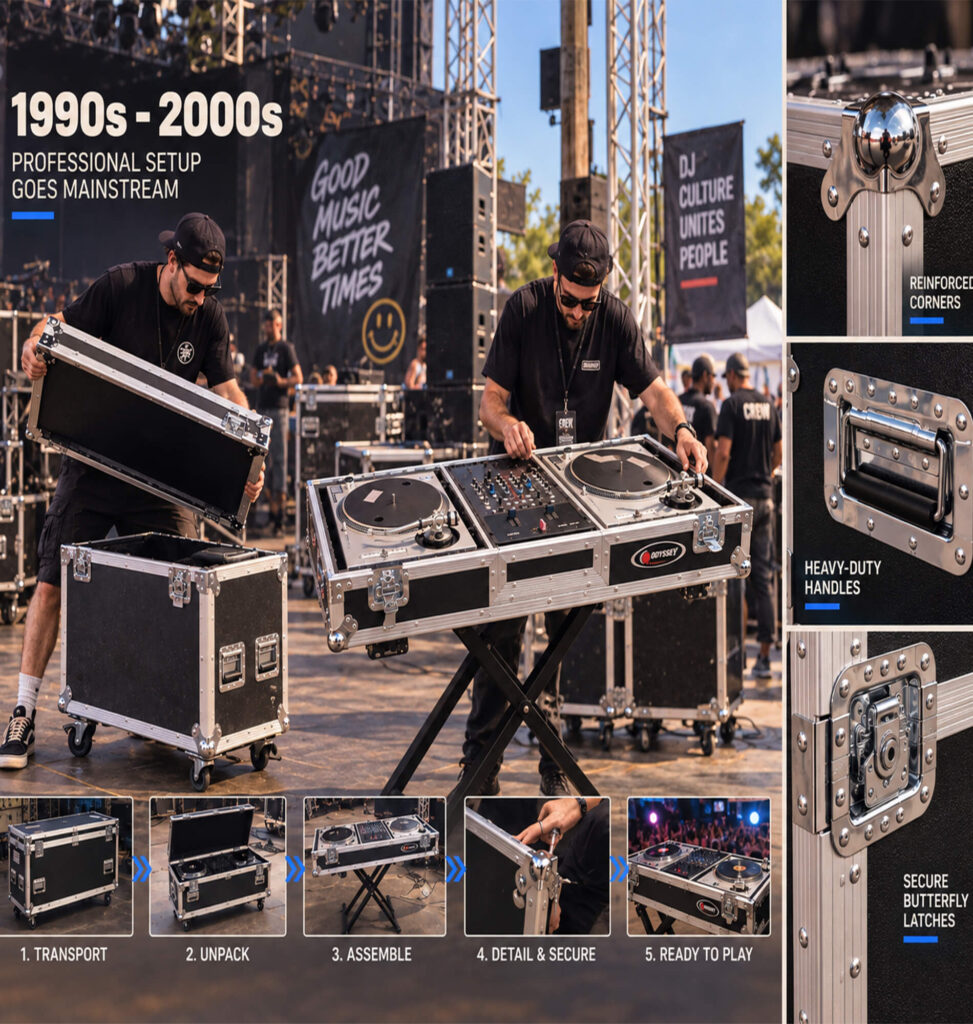
As mobile DJing became a viable career path through the 1990s and 2000s — weddings, corporate events, school dances — the fixed-furniture model stopped working. DJs needed gear that could survive being loaded into a van weekly and reassembled in a different venue every time. This gave rise to the flight case and rack-mount booth: modular aluminum-framed cases, often reinforced with metal corners, that doubled as both transport container and on-site facade once unpacked and configured. It was a major step toward portability, but assembly still typically took ten to twenty minutes and required real physical effort to lift and bolt together.
3. Modern Era: Foldable, Collapsible and LED Facades (2010s–Present)
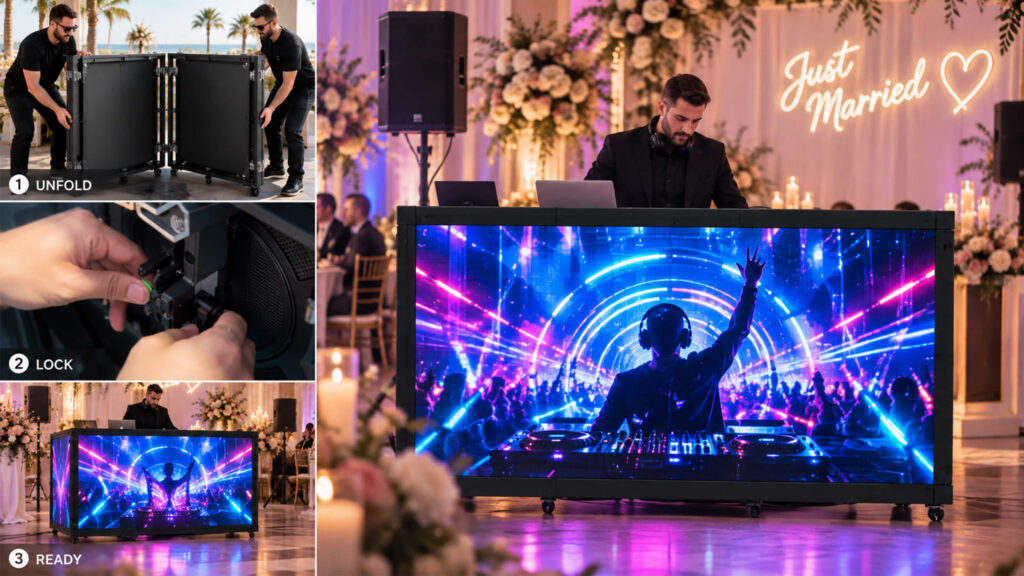
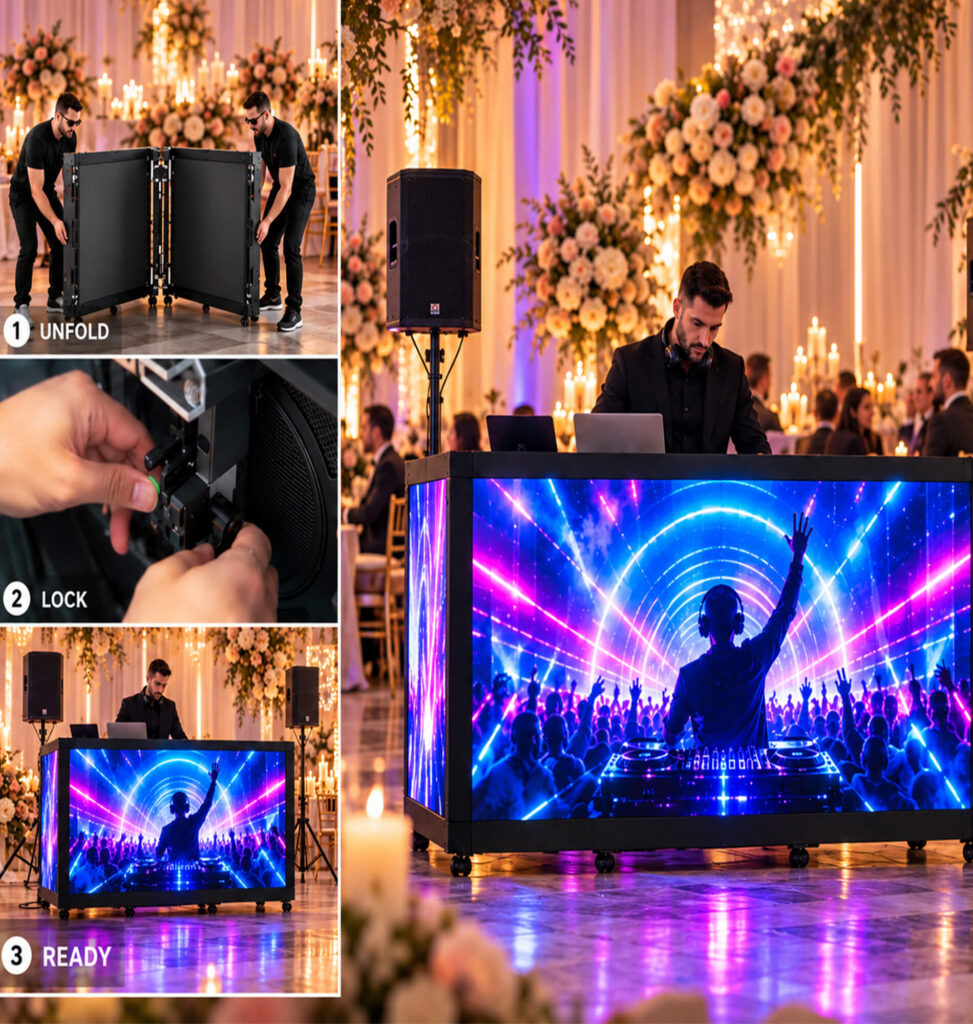
The current generation of DJ booths, which took hold through the 2010s, is defined by weight reduction and setup speed. Lightweight composite panels and aluminum frames replaced the heavier flight-case materials, hinged single-piece facades cut setup time down to minutes, and — more recently — built-in LED display panels turned the booth itself into a visual element of the performance rather than just a place to hide equipment. This shift tracks closely with the rise of social-media-documented events, where a booth’s on-camera appearance now matters almost as much as its function.
Common styles of DJ booths nowadays
1. Fixed and Furniture-Style Booths
Still found in permanent club installations today, fixed furniture booths are custom-built into a venue and never intended to move. They offer maximum durability and can be integrated with a venue’s cabling, lighting, and sound infrastructure in ways portable booths can’t match. The tradeoff is total inflexibility: this style only makes sense for a resident DJ or a venue owner, never for anyone working multiple locations.
2. Flight Case / Rack-Mount Booths
The flight case booth is the bridge between the old fixed-furniture era and today’s lightweight facades. Built from aluminum-framed cases with reinforced corners, it’s designed to be shipped, unpacked, and reconfigured into a booth shape on site. It remains a solid choice for DJs who also need serious equipment protection during transport — touring DJs and those working rougher venues in particular — but it’s heavier and slower to set up than the newer facade styles.
3. Foldable Facade Booths
The dominant style for weekend mobile DJs today, the foldable facade booth is a single hinged unit that opens and locks into place in under two minutes. It prioritizes setup speed and simplicity above almost everything else, which makes it especially well suited to DJs running back-to-back bookings — a ceremony followed by a reception, for example. The main tradeoff over time is hinge wear on high-frequency-use units.
4. Collapsible Panel Booths
Collapsible booths take a modular approach: separate frame sections and panel inserts that assemble on site and come fully apart afterward. Setup takes longer than a foldable unit — typically eight to fifteen minutes — but individual panels can be replaced or swapped for custom branding without replacing the whole booth. This makes it a stronger fit for DJs who gig frequently enough that long-term repairability matters, or who regularly need different branded panels for corporate clients.
5. Display-Equipped DJ Booths: The Modern Direction
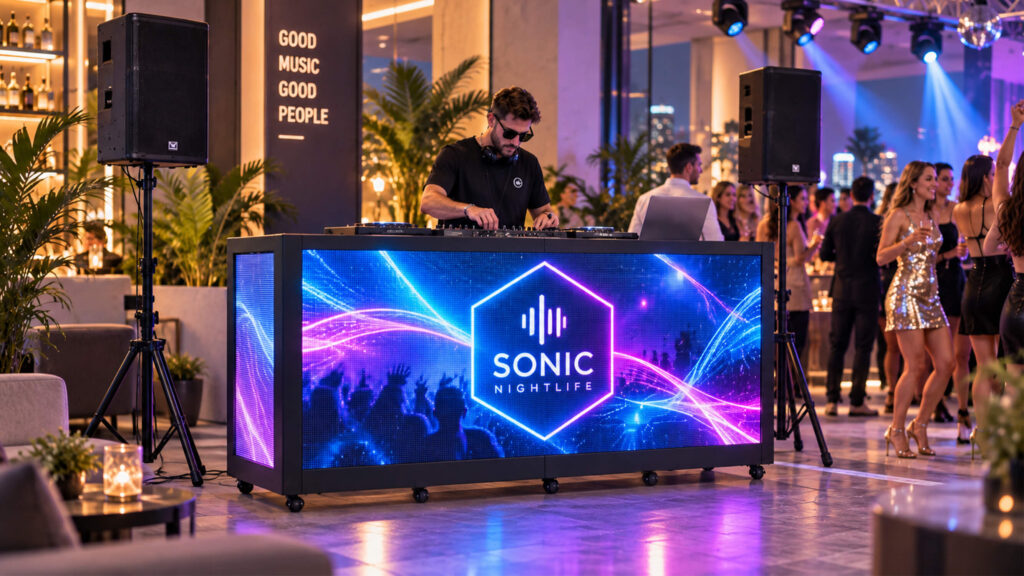
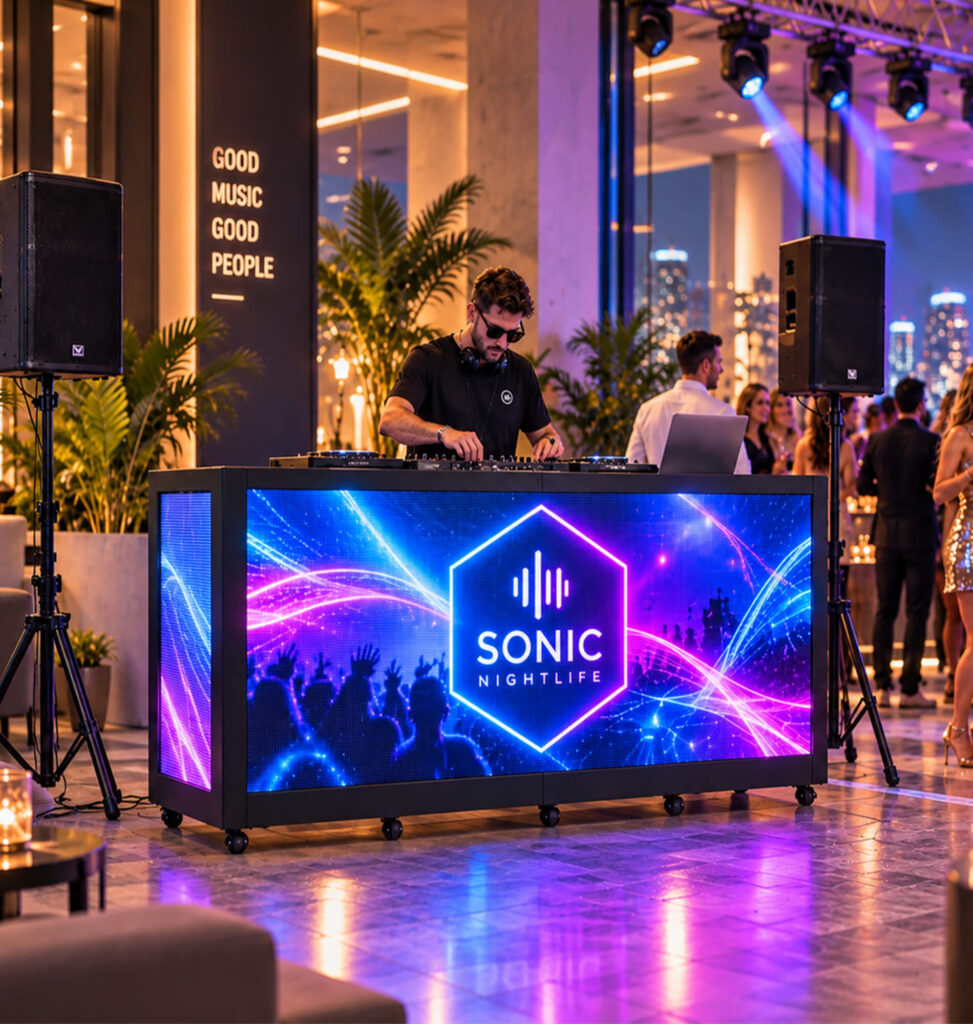
Display-equipped booths use lighting or screens to turn the front of the workstation into part of the event experience. This category includes three main designs.
| Display style | What it can show | Best suited to |
|---|---|---|
| RGB lighting panel | Colors and simple lighting effects | Parties, weddings and bars |
| DJ booth with TV mount | Logos, images and conventional video | Corporate events and presentations |
| LED video DJ booth | Animation, video, branding and sponsor content | Branded events, clubs and rental companies |
An RGB lighting booth provides color effects at a relatively low weight and cost. It can improve the atmosphere but cannot display detailed images or branded video.
A DJ booth with a TV mount uses a conventional LCD screen positioned above, behind or in front of the operator. This can be a practical choice for corporate events, although the television remains visually separate from the booth.
An LED video DJ booth integrates LED display modules into the front surface. It can show wedding names, event graphics, company logos, animations and sponsor content. The same physical booth can therefore be visually customized for different clients.
LED integration also adds technical considerations. Pixel pitch, viewing distance, refresh rate, brightness control, content input and maintenance access all affect the result. Protective transport packaging is particularly important because the display will be moved with the booth.
This design offers the strongest visual flexibility, but it is not automatically the best option for every operator. Its value depends on client demand, content quality, event frequency and the ability to charge for an upgraded visual experience.
Why the Modern LED DJ Booth Stands Apart
Traditional booths mainly solve a backstage problem: where to place equipment and how to hide cables. A modern LED DJ booth also addresses what the audience sees. Its front surface can change from a wedding monogram to a corporate brand animation or a nightclub visual without rebuilding the physical structure.
That distinction is especially important for event companies and rental operators. A printed facade is normally tied to one design, while an LED surface can support different clients using the same booth. The screen therefore becomes part of the service being sold, not merely decoration added to the workstation.
The most practical modern designs combine the LED display with a folding or modular frame. This allows the product to retain the visual impact of a stage display while remaining suitable for mobile events. However, the screen and structure must be designed together. Adding LED modules to an ordinary table can create poor weight distribution, exposed wiring and difficult maintenance.
| Design factor | Why it matters in a modern LED DJ booth |
|---|---|
| Integrated structure | Keeps the display, work surface and frame stable as one system |
| Folding or modular design | Supports transport, repeated setup and component replacement |
| Appropriate pixel pitch | Keeps logos, names and graphics clear at the expected viewing distance |
| High refresh rate | Helps the screen appear clean in event photos and video recordings |
| Adjustable brightness | Prevents the display from overpowering indoor lighting or photography |
| Front or easy service access | Reduces downtime when a module or power component needs attention |
| Protective transport case | Protects LED modules and connectors during repeated rental use |
The LED booth is therefore the most advanced category in this guide, but its advantage comes from integration rather than from the screen alone. A successful design has to work as a DJ workstation, a transportable product and a digital display at the same time.
DJ Booth Type Comparison
| Application | Recommended DJ booth types | Main priority |
|---|---|---|
| Solo mobile DJ | Folding or collapsible booth | Weight and one-person setup |
| Wedding company | Facade, furniture-style or LED booth | Appearance and personalization |
| Corporate events | Modular, TV-mount or LED booth | Branding and content control |
| Rental company | Folding or modular booth | Durability and replaceable parts |
| Nightclub | Permanent built-in booth | Stability and equipment access |
| Festival or concert | Stage-integrated booth | Production and structural planning |
| Hotel or lounge | Furniture-style booth | Interior design and cable concealment |
| Small private events | Basic stand or facade | Cost and simple transportation |
The application is only a starting point. A wedding DJ working mainly in luxury hotels may require a different solution from one serving small community venues. Equipment quantity, vehicle space, setup crew and client expectations must also be considered.
How to Choose Between DJ Booth Types
Begin with the equipment rather than the booth’s appearance. Measure the controller, mixer, laptop, turntables and any additional hardware that must fit on or inside the workstation. Allow enough space for cable connectors, ventilation and comfortable operation.
Next, consider how the booth will move. Buyers should compare the open dimensions with the packed dimensions and confirm the total weight as well as the weight of the heaviest component. Vehicle access, elevators, storage areas and venue doors can all limit the practical size.
The structure should remain stable after the equipment and any display have been installed. This is especially important for booths with TV mounts or elevated screens because the added weight changes the center of gravity.
Finally, confirm what is included in the quotation. A facade may exclude the equipment table, while an LED DJ booth quotation may exclude control equipment, transport cases, cables or spare modules. Comparing complete systems is more useful than comparing only the visible booth price.
Final Thoughts
The evolution of the DJ booth reflects the changing role of the DJ. It began as a functional equipment desk, became part of nightclub architecture, adapted to mobile event work and eventually developed into a digital display platform.
There is no single best DJ booth type. Traditional stands offer simplicity, facades improve presentation, folding booths support mobile work, modular systems provide flexibility, and built-in booths serve permanent venues. Furniture-style designs focus on appearance, while LED DJ booths add dynamic content and branding.
The right choice depends on four practical questions: what equipment the booth must hold, how often it will move, who will assemble it, and what the audience needs to see.
If you are evaluating a portable or LED-equipped DJ booth for mobile events, venue installations or rental projects, Yinglux can help you review the structure, display configuration, transport method and content-control requirements. Share your application, equipment list, preferred dimensions and typical viewing distance with the Yinglux team to discuss a suitable DJ booth solution.
FAQ
Q1: What is a DJ booth, and what essential equipment does it house?
A DJ booth serves as the central command station for live music mixing and audio performance. It provides a stable, professional platform designed to house core DJ gear, including:
Core Mixing Gear: Media players, CDJs, vinyl turntables, DJ controllers, and audio mixers.
Peripherals & Accessories: Laptops, monitor headphones, PA system controls, and cable management tools.
Visual Controls: Lighting controllers, DMX consoles, and integrated video display processors.
Q2: What are the main types of DJ booths available on the market?
Depending on the event setup and installation requirements, DJ booths are generally categorized into three main types:
- Portable & Mobile DJ Booths:
- Foldable Facade Booths: Constructed with lightweight aluminum or truss frames and interchangeable black/white fabric scrims. They fold flat for fast transport and effectively conceal internal wiring—ideal for mobile DJs, weddings, and private events.
- Tabletop / Stand Rigs: Compact folding tables or X-stands designed for quick assembly and small footprint requirements.
- Club & Permanent Installation Booths:
- Custom Built-ins: Constructed from heavy-duty wood, acrylic, or metal to match a venue’s interior layout, providing superior acoustic isolation and durability.
- Sit/Stand Ergonomic Consoles: Height-adjustable desks designed for resident DJs and producers who switch between long standing sets and seated track arrangement.
- High-Tech & Display DJ Booths:
- LED Screen / Video Wall Booths: Modular setups integrated with high-refresh LED panels that display 270-degree animated graphics, custom logos, or music-synced visuals.
- Command Center Rigs: Multi-tiered festival stations incorporating heavy trussing, overhead lighting bars, and embedded display screens for maximum visual impact.
Q3: What are the standard dimensions and height for a professional DJ booth?
- Standard Height: Professional DJ booths are ergonomically designed for standing performance, with a standard table surface height between 90 cm and 100 cm (36 to 40 inches). This height range minimizes strain on the DJ’s back and arms during extended sets.
- Width & Depth: A basic setup accommodating two CDJs and a mixer requires a minimum width of 120 cm to 150 cm (48 to 60 inches). Larger setups featuring 4 CDJs, turntables, or multi-channel controllers require custom or expandable booths exceeding 180 cm (70 inches) in width.
Q4: Key factors to consider when choosing or building a DJ booth
When selecting the ideal DJ booth for commercial or event use, consider the following key aspects:
Mobility vs. Permanence: Determine whether you need lightweight, tool-free assembly for mobile events, or heavy-duty architectural builds for permanent venue installation.
Gear Footprint & Load Capacity: Verify the total dimensions and weight of all equipment to ensure the desk surface provides adequate space and structural load capacity.
Cable Management & Clean Appearance: Look for built-in wire pass-through holes, lower shelves, or front facade panels to keep cables hidden from the audience.
Visual Branding & Illumination: Decide whether adding custom graphics, LED light bars, or integrated LED display screens is required to match your brand identity or stage lighting atmosphere.