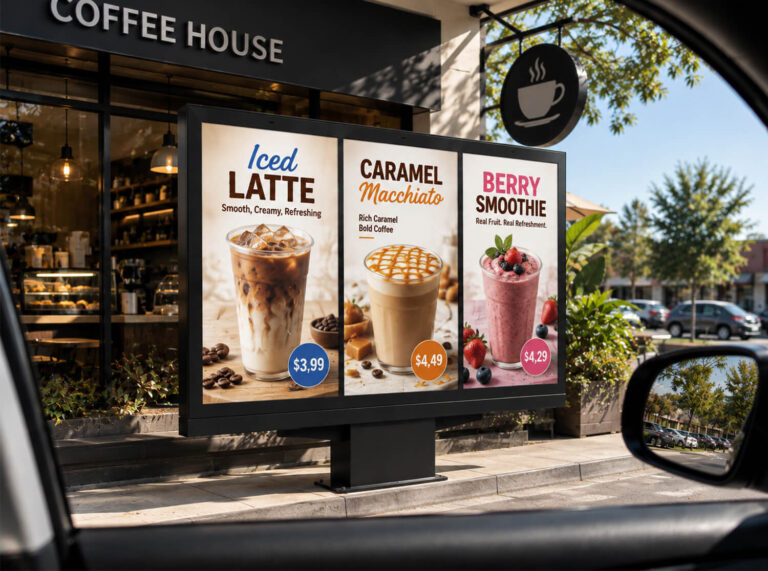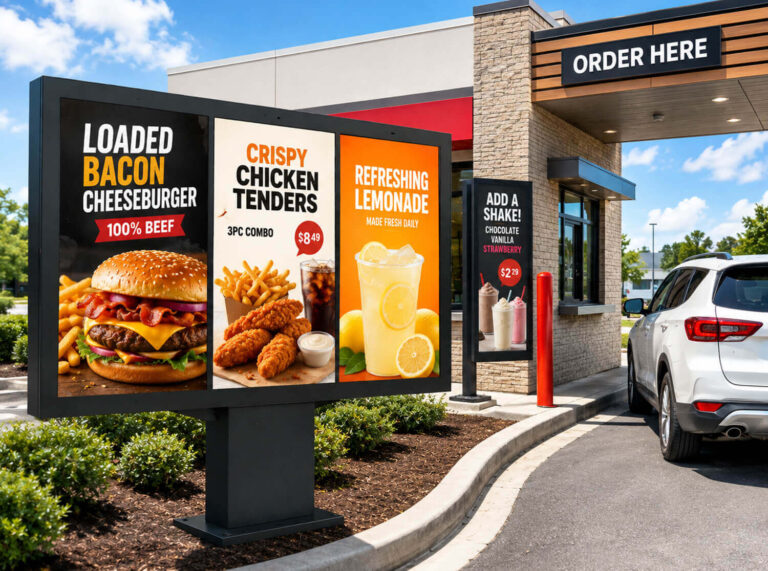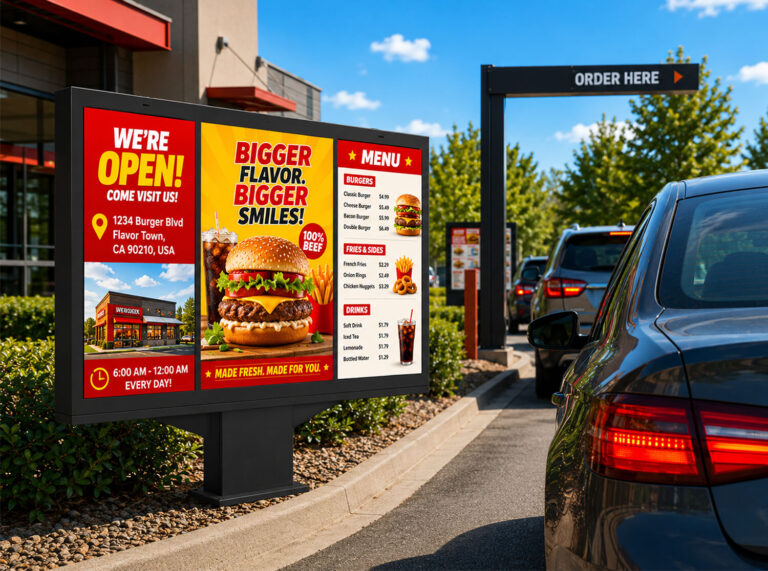
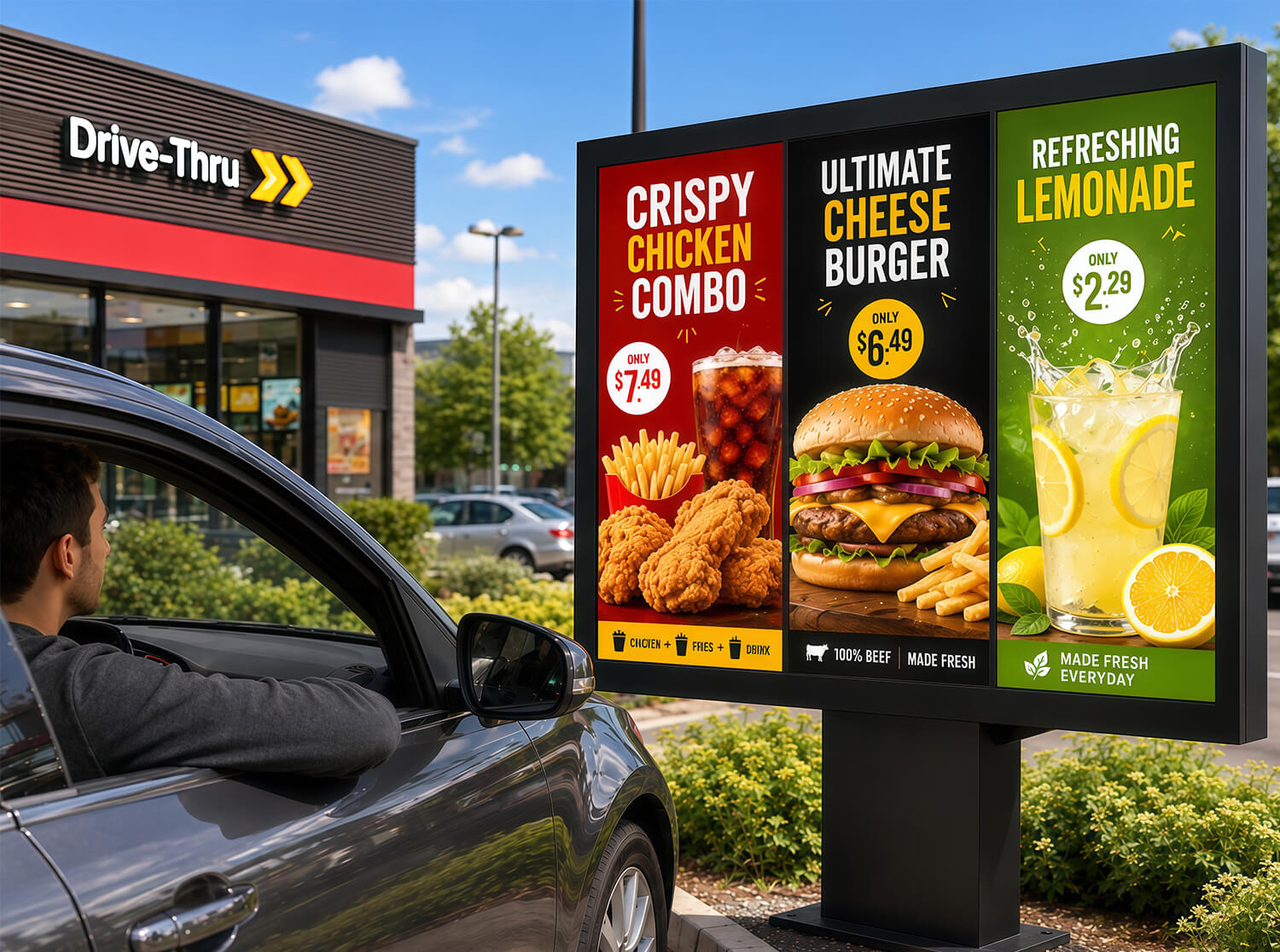
For many quick-service restaurants, the menu board is one of the most visible parts of the customer journey. Industry research indicates that digital signage attracts more attention than static displays; up to 68% of customers state that digital signage increases their willingness to purchase advertised products, and nearly 30% of customers have their ordering choices directly influenced by digital menu boards.
It introduces the menu, communicates prices, highlights promotions, and helps customers decide what to order. Amidst increasingly fierce market competition, restaurants must not only contend with frequent adjustments to menus and promotions but also adapt to a changing consumer landscape. According to QSR Magazine, consumers are becoming less tolerant of rising prices, compelling restaurants to find new ways to attract and satisfy increasingly price-conscious customers while maintaining profitability. Digital signage offers an effective solution to this challenge; data shows that over 80% of restaurant owners report a significant increase in order volume after adopting digital signage technology. This is precisely why a growing number of restaurants are choosing to integrate digital menu boards into their operations.
The question is not simply whether digital menu boards look better. The more important question is whether their operational and marketing benefits justify the investment.
For a restaurant with frequent menu changes, seasonal promotions, multiple locations, or a high-volume drive-thru, the answer can be very different from that of a small restaurant with a stable menu. Understanding the actual benefits of digital menu boards can help operators determine whether the technology makes business sense for their operation.
Why Are Restaurants Moving to Digital Menu Boards?
The biggest difference between a traditional menu board and a digital menu board is flexibility. A printed board communicates a fixed menu until someone physically changes it. A digital display allows the content to change as the restaurant’s menu, promotions, and business priorities change.
This flexibility is particularly valuable in the quick-service restaurant industry, where menus can change frequently. Limited-time offers, seasonal products, price adjustments, and meal-period promotions all require restaurants to communicate different information at different times. This flexibility extends beyond marketing; it directly optimizes the customer experience regarding ordering and waiting. Dynamic, engaging visual content conveys product information while simultaneously capturing customers’ attention, reducing perceived wait times by up to 35%. Coupled with features such as real-time order updates and multilingual interfaces, digital menu boards not only make the transaction process clearer and more user-friendly but also overcome language barriers, significantly streamlining the overall service workflow.
Instead of treating the menu board as a permanent piece of printed material, digital technology turns it into a communication channel that can be updated when needed.
For drive-thru restaurants, this can be especially useful because customers typically have only a limited amount of time to review the menu before placing an order. The ability to control what information appears on the screen can help restaurants present the most relevant products and promotions at the right moment.
Digital Menu Board Benefits for Restaurant Operations
One of the most practical digital menu board benefits is the ability to make changes without physically replacing printed materials.
With a traditional menu board, a price change or new product may require redesigned artwork, printing, delivery, and manual installation. If the same change needs to be made across several locations, the process becomes even more time-consuming.
Digital menu boards change this workflow. Once new content has been prepared, it can be distributed electronically through the restaurant’s digital signage system. This means a menu update that previously required physical work can become a content management task.
The difference becomes more significant as the number of locations increases. A single restaurant may not spend much time replacing printed materials, but a franchise group managing dozens or hundreds of locations faces a very different operational challenge.
Digital menu boards can therefore provide value not only through the display itself, but also through the reduction of repetitive manual work.
More Flexibility for Promotions and Menu Changes
Restaurants rarely sell exactly the same products in exactly the same way throughout the year. Breakfast menus may be different from lunch menus. Seasonal products may only be available for several weeks. Limited-time offers may need to be promoted aggressively before they expire.
A digital menu board makes these changes easier to manage.
For example, a restaurant can use different menu content for different meal periods rather than displaying the same information throughout the day. A breakfast promotion can be replaced by lunch content, while a seasonal promotion can be scheduled to appear only during a specific campaign period.
This flexibility can also support upselling. Instead of giving every menu item equal visual importance, restaurants can give greater attention to selected combinations, premium products, add-ons, or limited-time offers.
The purpose is not simply to put more content on the screen. Effective digital menu content should help customers understand their options quickly while giving the restaurant greater control over which products receive attention.
Can Digital Menu Boards Help Increase Sales?
A digital menu board should not be treated as a guaranteed sales-growth tool. Customer behavior depends on many factors, including pricing, product quality, traffic, service speed, location, and the overall restaurant experience.
However, digital technology can create more opportunities for restaurants to influence purchasing decisions.
A static menu may show the same promotional message for weeks. A digital menu can change the message according to the time of day, current promotions, or product availability. This gives restaurants more opportunities to highlight combinations, upgrades, seasonal products, and other items they want customers to notice.
For example, instead of simply displaying a burger and its price, a restaurant could use the menu presentation to emphasize a meal combination or an add-on. During a limited-time campaign, the same screen could give the promotional item greater visibility without requiring a physical redesign.
The value comes from flexibility rather than from the screen itself. Digital menu boards give operators more control over the information customers see during the ordering process.
The Value Becomes Greater at Multiple Locations
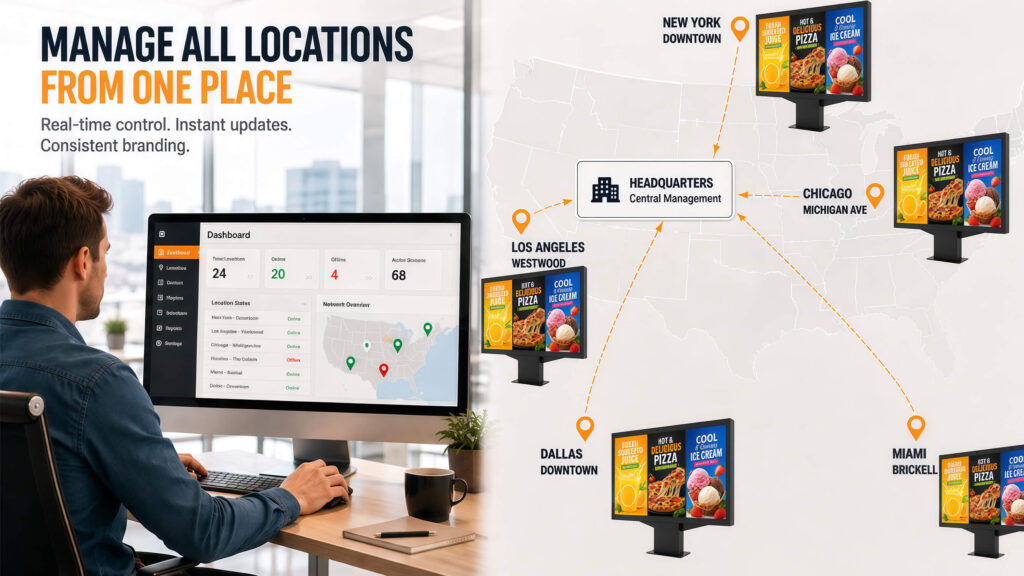
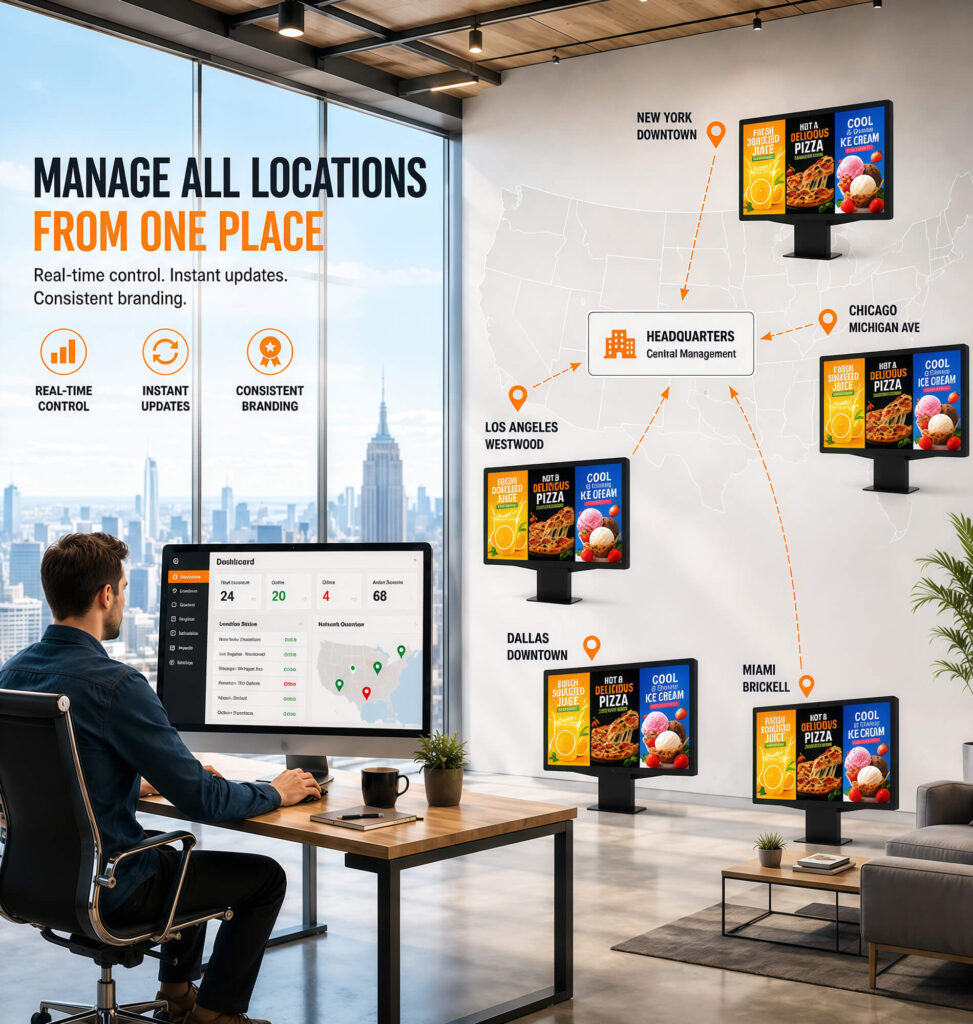
For a single restaurant, the business case for digital menu boards may depend heavily on menu update frequency and promotional activity. For multi-location restaurants, the calculation can be different.
Imagine a restaurant group operating 50 locations. A change to the menu may involve updating printed materials, distributing them to each restaurant, and ensuring that every location replaces the old version correctly.
With centralized digital content management, the same campaign can potentially be prepared and distributed across multiple locations without repeating the physical replacement process at every store.
This can help improve consistency as well. When prices, promotions, and brand messaging change, operators can manage content more systematically across locations instead of relying entirely on local teams to update physical menu boards.
For franchise businesses and growing QSR groups, this scalability can become one of the strongest reasons to consider digital signage.
What Is the ROI of a Digital Menu Board?
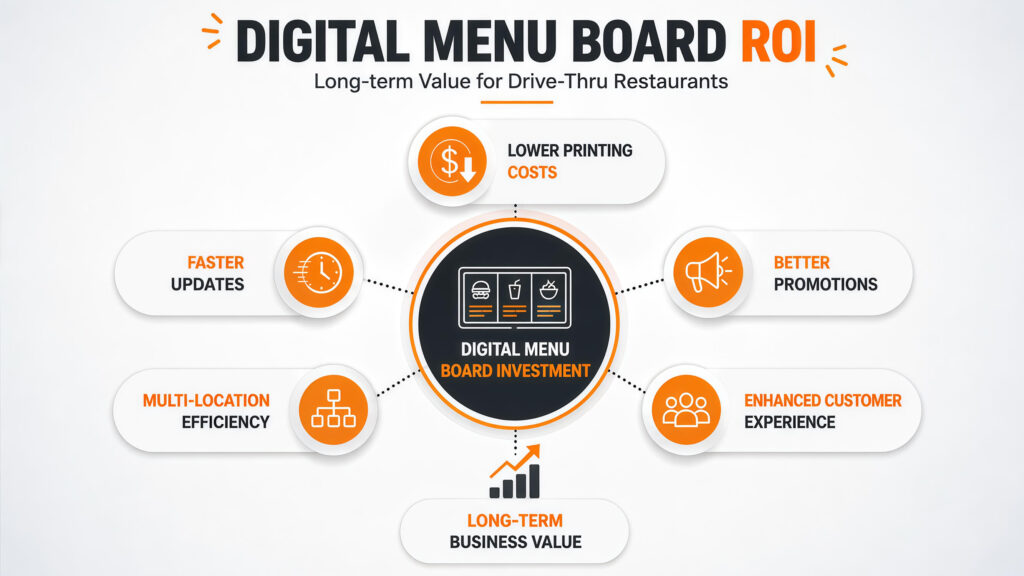
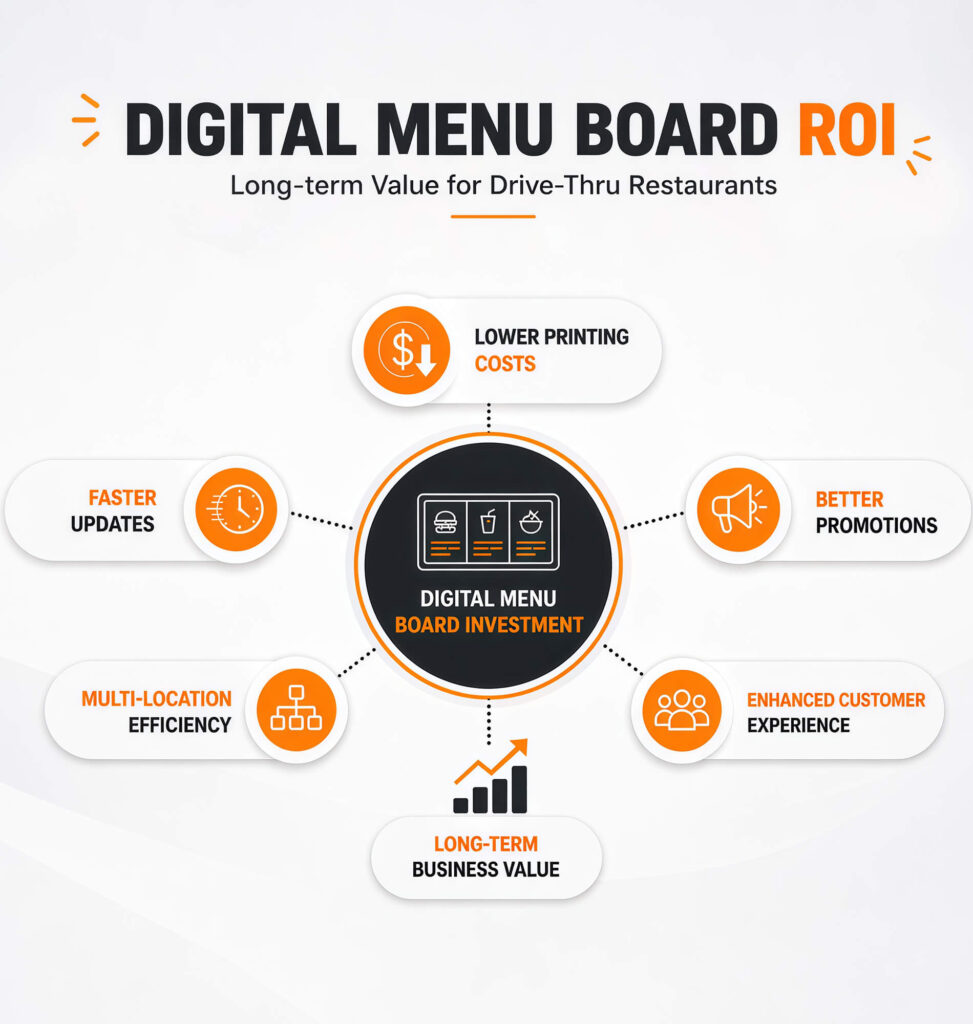
The return on investment of a digital menu board should not be measured only by comparing its purchase price with the cost of a printed board.
A more useful approach is to consider the total value generated throughout the system’s operating life.
Potential value can come from reduced printing and replacement requirements, less manual work, faster content updates, improved promotional flexibility, and easier management across multiple locations. There may also be opportunities to support higher-value products and promotions through better menu presentation.
A simple ROI calculation can be expressed as:
ROI = (Total Gains − Total Investment) ÷ Total Investment × 100%
The challenge is that not every benefit is immediately measurable. Printing savings are relatively easy to calculate, while the value of faster promotions or centralized management may be more difficult to quantify.
For this reason, restaurant operators should look at the investment over its expected operating period rather than judging it only by the initial purchase price.
Our [Digital Drive-Thru Menu Board Cost in 2026] can be used as a starting point for understanding the different cost components involved in a digital menu board project.
When Is a Digital Menu Board Worth the Investment?
Digital menu boards are generally more attractive for restaurants where menu flexibility and operational efficiency have a meaningful financial impact.
| Restaurant Situation | Potential Value of Digital Menu Boards |
|---|---|
| Menu changes frequently | High |
| Regular limited-time promotions | High |
| Multiple restaurant locations | High |
| Franchise operations | High |
| Seasonal menu changes | High |
| High-volume drive-thru | High |
| Menu rarely changes | Moderate to Low |
| Small operation with limited promotions | Depends on the use case |
A restaurant that changes its menu only once or twice a year may not benefit from digital flexibility as much as a QSR running frequent promotions and seasonal campaigns.
Likewise, a restaurant with one location may have a different ROI calculation from a franchise group managing dozens of stores.
The key is to evaluate how often the restaurant needs to change information and how much operational work is currently involved in managing those changes.
When Might a Traditional Menu Board Still Make Sense?
Digital technology is not automatically the best choice for every restaurant.
If a restaurant has a very stable menu, rarely changes prices, operates only one location, and has limited promotional activity, a traditional menu board may still be a practical and cost-effective solution.
The same applies to temporary locations or businesses where menu information changes very little over time.
The goal should not be to replace traditional signage simply because digital technology is newer. The better approach is to determine whether the flexibility and operational benefits of digital signage solve a real business problem.
What Should Restaurants Consider Before Investing?
Before making a decision, restaurant operators should look beyond the display and consider how the system will fit into their daily operation.
The first question is how frequently the menu changes. If prices, products, and promotions are updated regularly, digital flexibility becomes more valuable.
The second is the number of locations. The larger the restaurant network, the more potential value centralized content management can provide.
The third is the restaurant’s promotional strategy. Businesses that rely heavily on limited-time offers, seasonal campaigns, dayparting, and upselling may benefit more from being able to change menu content quickly.
Finally, operators should consider the entire lifecycle of the system, including content management, maintenance, technical support, and future expansion. A digital menu board is a long-term operational tool, so the decision should be based on its expected value over time rather than its initial price alone.
For a more detailed purchasing framework, see our [Drive-Thru Procurement Guide to the Right Menu Boards].
Digital Menu Boards vs. Traditional Menu Boards
The difference between digital and traditional menu boards is ultimately a difference in flexibility.
| Factor | Traditional Menu Board | Digital Menu Board |
|---|---|---|
| Initial investment | Lower | Higher |
| Content updates | Physical replacement | Digital update |
| Promotional flexibility | Limited | High |
| Menu changes | Slower | Faster |
| Multi-location management | More manual | More centralized |
| Printing requirements | Ongoing | Reduced |
| Long-term flexibility | Limited | High |
Traditional boards can remain a sensible choice for businesses with simple and stable menus. Digital menu boards become more attractive when a restaurant needs to communicate changing information frequently and manage that information efficiently.
Final Verdict: Are Digital Menu Boards Worth It?
There is no universal answer for every restaurant.
For a small operation with a stable menu, the additional investment may not provide enough value to justify the change. But for high-volume drive-thru restaurants, QSRs, franchises, and multi-location businesses, the ability to update menus quickly, manage promotions, and maintain consistent content can provide meaningful long-term value.
The strongest business case is therefore not simply about having a more modern-looking menu board. It is about improving how a restaurant manages information and communicates with customers.
Instead of asking only, “How much does a digital menu board cost?”, operators should also ask, “How much flexibility, efficiency, and operational value can it provide over its lifetime?”
For restaurants where menu changes, promotions, and multi-location management are part of everyday operations, that broader perspective can make a digital menu board a worthwhile long-term investment.
Ready to Upgrade Your Restaurant’s Menu Experience?
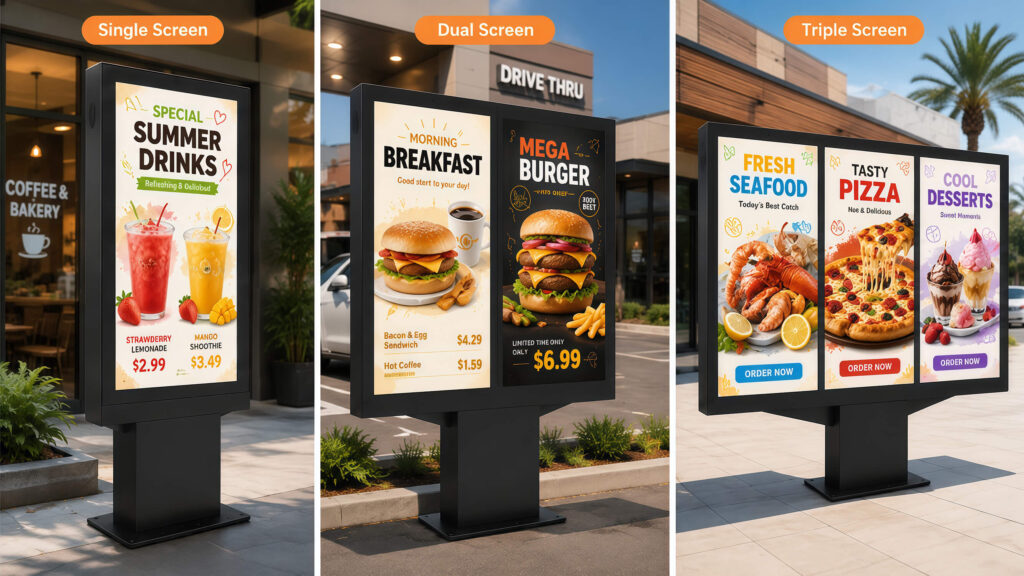
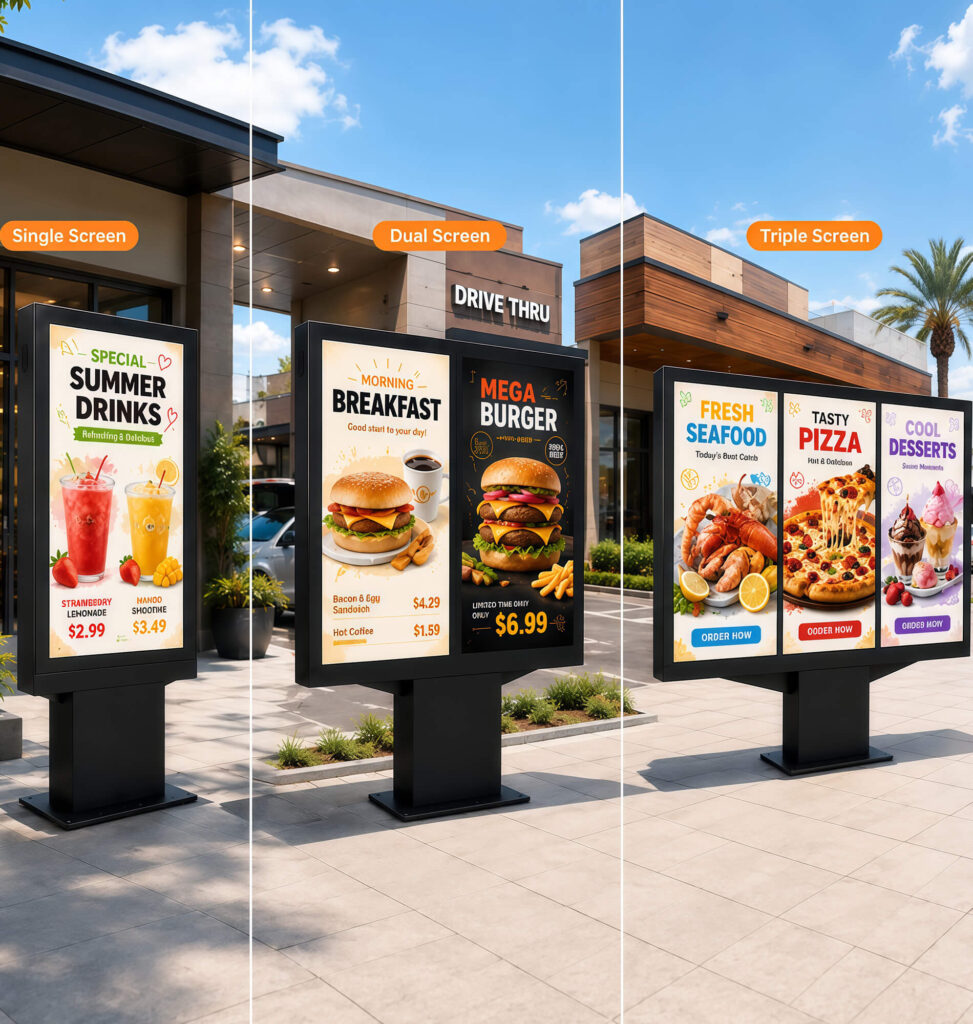
Whether you’re operating a single QSR location or managing a multi-unit franchise network, switching to a digital menu board system simplifies menu management, boosts promotional efficiency, and delivers a modern customer experience.
Explore our comprehensive Drive-Thru Procurement Guide to the Right Menu Boards to find the perfect display solution for your business, or contact our solution experts today for a customized hardware and software quote.
FAQ
How much does a digital menu board system cost?
Costs vary based on hardware (commercial-grade displays), software subscriptions (CMS), installation, and enclosure choices for indoor vs. drive-thru environments. For a detailed breakdown, check our guide on Digital Drive-Thru Menu Board Cost in 2026.
Can I update menu prices and items remotely across multiple locations?
Yes. Using a cloud-based Content Management System (CMS), operators can update prices, add new promotional items, or schedule dayparting (e.g., breakfast to lunch menus) across one or hundreds of locations instantly from a single dashboard.
Do digital menu boards really increase sales for quick-service restaurants?
While sales growth depends on multiple factors like pricing and product quality, dynamic displays significantly improve item visibility. Highlights on high-margin combos, limited-time offers, and strategic upsells can increase average order value by 3% to 5%.
What display hardware is best for drive-thru menu boards?
Drive-thru displays require high-brightness, weather-resistant commercial screens (typically 2,500+ nits) housed in IP-rated protective enclosures to withstand direct sunlight, extreme temperatures, and moisture.