The Right Digital A-Frame Size Is Not Always the Biggest One
When businesses invest in a digital A-frame sign, one of the first questions they usually ask is:
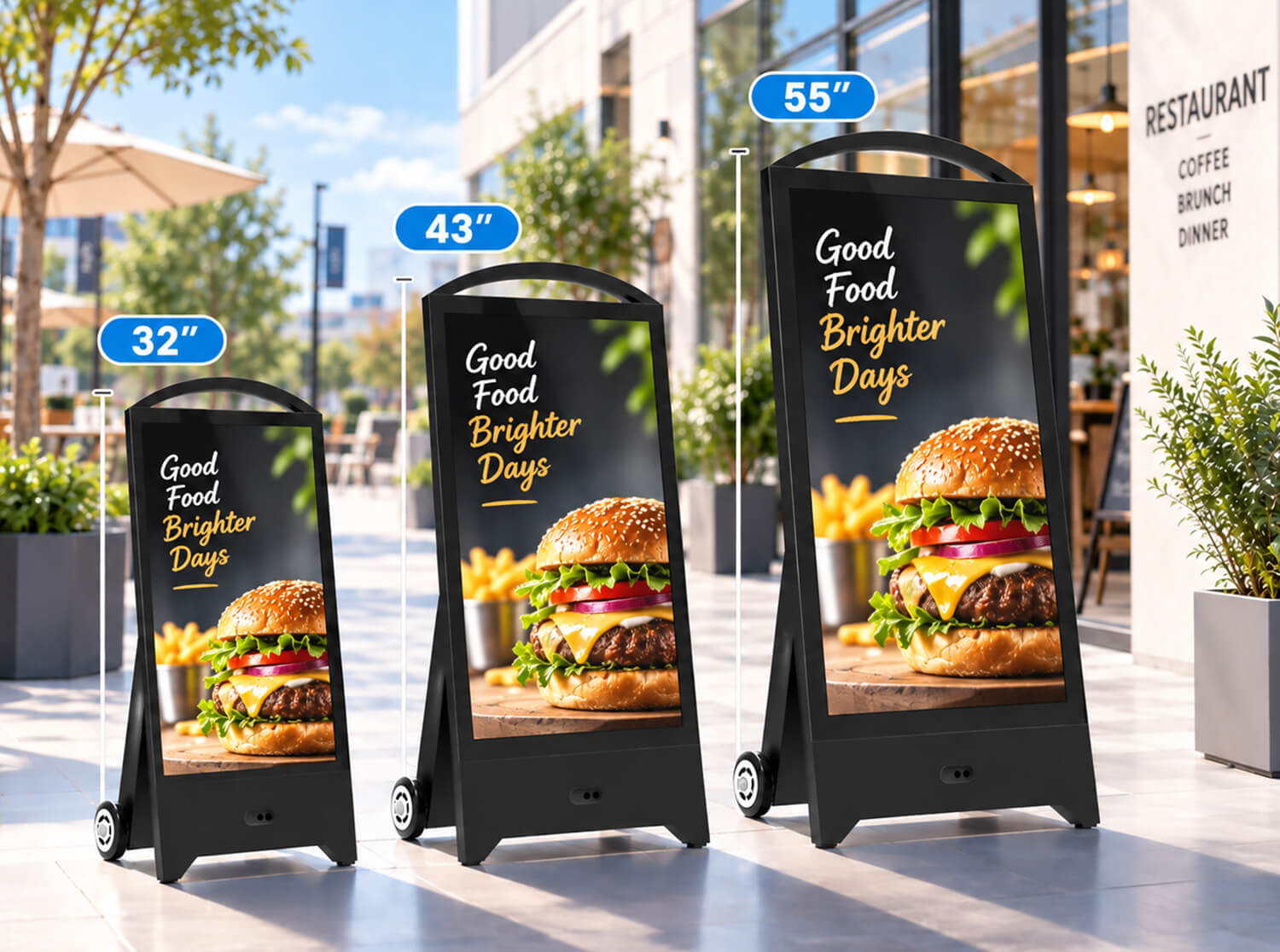
“Should we choose a 32-inch, 43-inch, or 55-inch display?”
At first glance, choosing a larger screen seems like the obvious answer. A bigger display creates a stronger visual impact, so many buyers assume that a 55-inch digital A-frame must always deliver better results.
However, professional digital signage selection is not simply about buying the largest screen available.
A 55-inch display placed in a small store entrance may take up unnecessary space, while a well-positioned 43-inch display may deliver better engagement. Likewise, a 32-inch model can be highly effective when customers view it from a close distance.
The right question is not:
“What is the biggest digital A-frame sign I can buy?”
The better question is:
“What screen size allows my customers to clearly see, understand, and respond to my message?”
This guide explains the differences between 32-inch, 43-inch, and 55-inch digital A-frame signs and helps businesses choose the right size based on real commercial applications.
Why Digital A-Frame Sign Size Matters
Unlike wall-mounted displays inside stores, digital A-frame signs are usually placed in customer traffic areas.
People typically see them while:
- walking past a storefront
- entering a restaurant
- waiting in line
- attending an event
- moving through a shopping area
This means businesses often have only a few seconds to capture attention.
A successful digital A-frame display needs to achieve three things: First, customers should notice it.Second, they should quickly understand the message.Third, the content should encourage them to take action, such as entering a store, placing an order, or learning more about a product.
Screen size directly affects this process.
A smaller display may be easier to move and install, but it may not attract enough attention in a large environment.
A larger display creates stronger visibility, but it also requires more space and investment.
The goal is not simply choosing the biggest screen.
The goal is choosing the screen size that matches customer behavior.
Start With Viewing Distance: The Most Important Factor
One of the most common mistakes businesses make is choosing a digital A-frame sign based only on available space or budget.
Professional buyers usually start with a different question:
How far away will customers see this display?
Viewing distance determines whether customers can comfortably read text, recognize images, and understand promotional messages.
A general guideline:
| Screen Size | Recommended Viewing Distance | Suitable Applications |
|---|---|---|
| 32 inch | About 1–3 meters | Small stores, entrances, indoor spaces |
| 43 inch | About 2–5 meters | Restaurants, retail stores, exhibitions |
| 55 inch | About 4 meters and beyond | Outdoor advertising, malls, large commercial areas |
These distances are not fixed rules. Brightness, resolution, viewing angle, and content design also influence visibility.
For example, a bright outdoor 43-inch display may perform better than a low-brightness 55-inch screen.
Screen size should always be considered together with the environment.
32-Inch Digital A-Frame Sign: The Compact Solution for Close-Range Communication

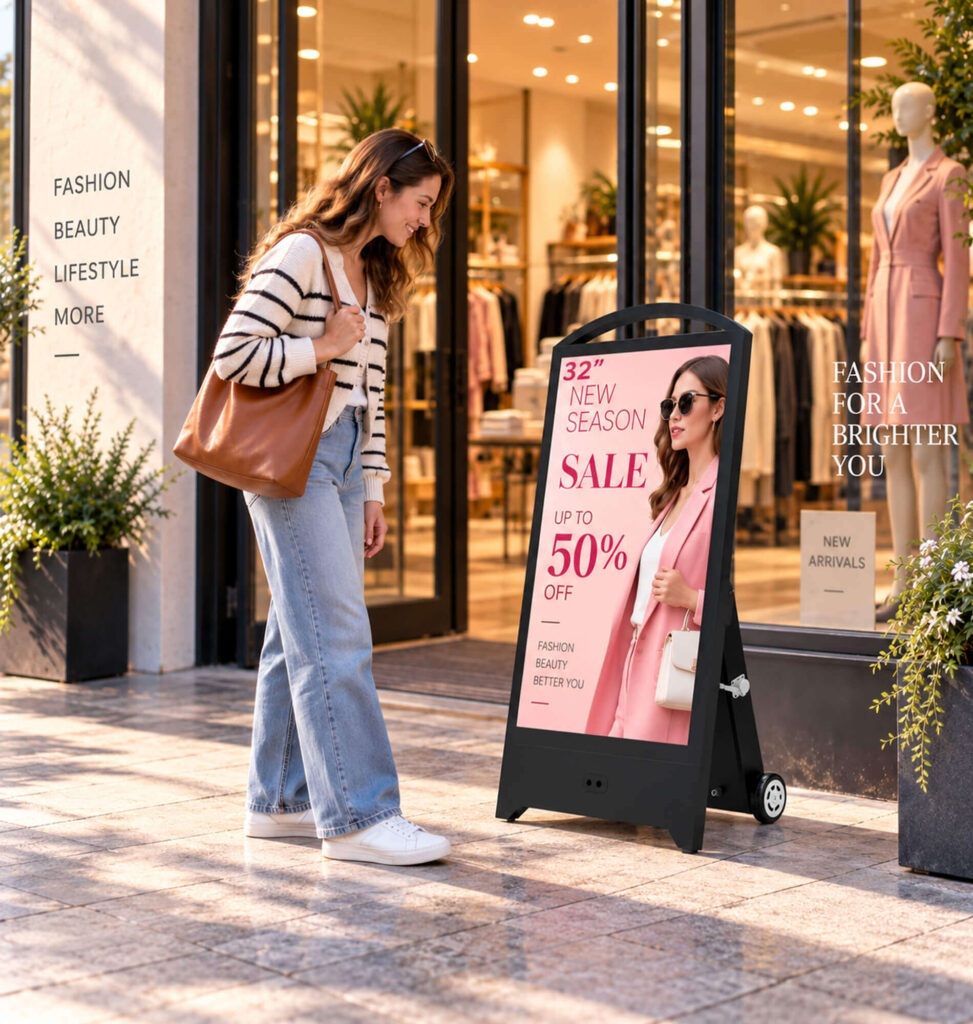
A 32-inch digital A-frame sign is usually the best choice when customers view the display from a relatively short distance.
It works well for:
- small retail stores
- cafes
- salons
- reception areas
- indoor promotions
- compact exhibition booths
The biggest advantage of a 32-inch model is flexibility.
Because of its smaller footprint, it is easier to move, store, and reposition. Businesses that change locations frequently or have limited space often prefer this size because it fits naturally into the customer environment.
For example, a boutique store may only need a display near the entrance to promote a new collection or seasonal discount. In this situation, a 32-inch screen can communicate the message effectively without overwhelming the space.
However, businesses should understand its limitation.
A 32-inch display is designed for close interaction rather than long-distance attraction.
If the sign is placed outdoors on a busy street or in a large commercial area, customers may not notice the content quickly enough.
A smaller screen is not a problem when the viewing distance is correct. The problem occurs when businesses expect a compact display to perform like a large advertising screen.
43-Inch Digital A-Frame Sign: The Most Versatile Choice for Most Businesses
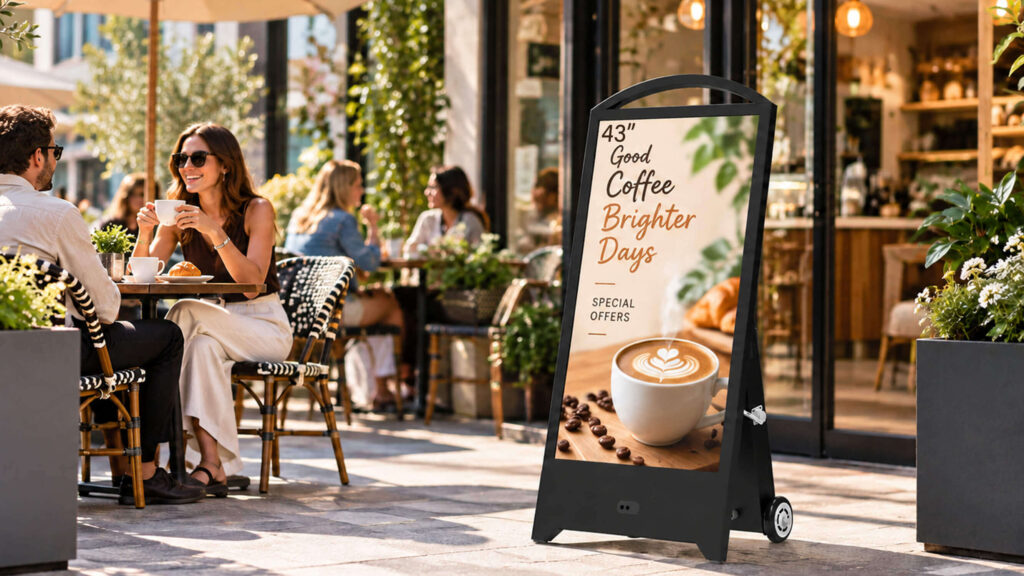
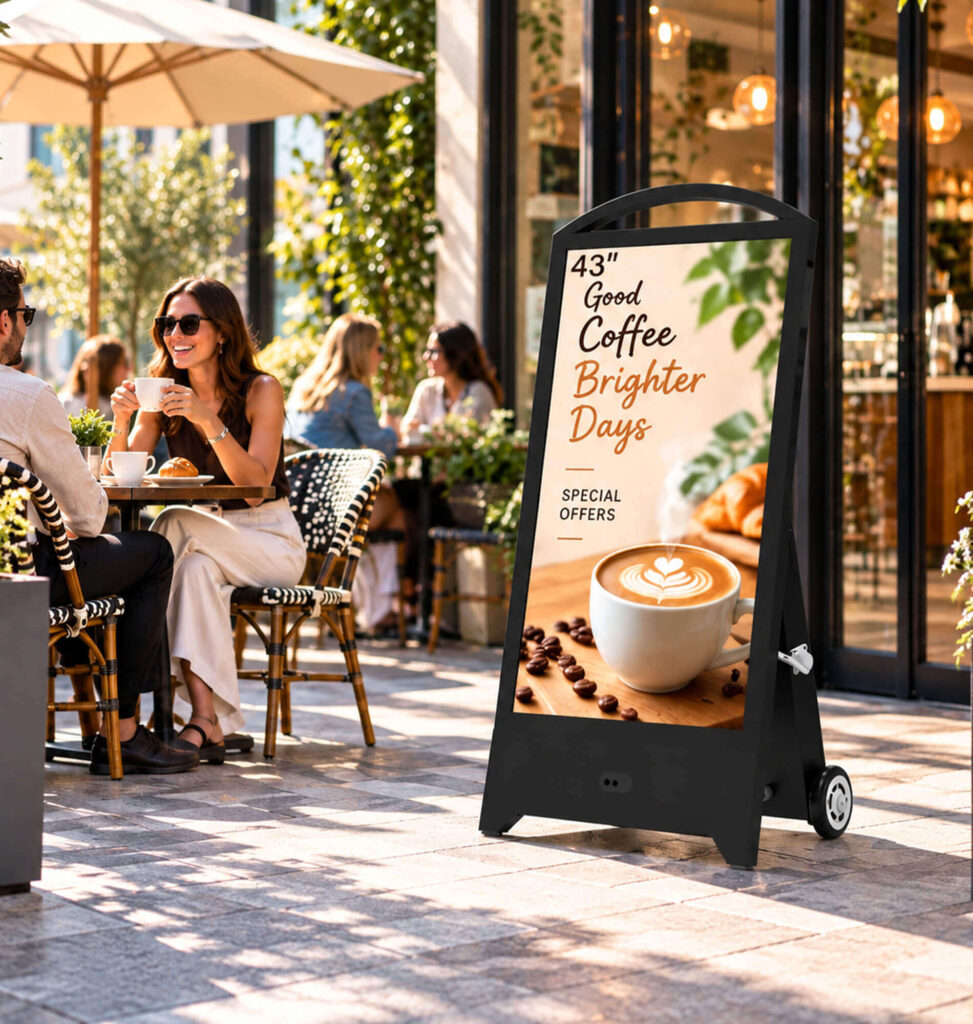
For many commercial applications, a 43-inch digital A-frame sign provides the best balance between visibility, portability, and cost.
This size has become popular because it works well in a wide range of environments, including:
- restaurants
- retail stores
- hotels
- shopping centers
- trade shows
- business events
The reason is simple:
Most customers interact with digital signage from a medium distance.
They are not standing directly in front of the screen, but they are also not viewing it from across a large space.
A 43-inch display provides enough room for:
- promotional videos
- product images
- digital menus
- advertising messages
- brand content
while remaining practical for daily operation.
For businesses purchasing their first digital A-frame sign, 43 inches is often the safest choice because it covers the widest range of applications.
It offers stronger visibility than a 32-inch model while avoiding some of the space and mobility challenges of a 55-inch display.
55-Inch Digital A-Frame Sign: Maximum Visual Impact for Large Spaces
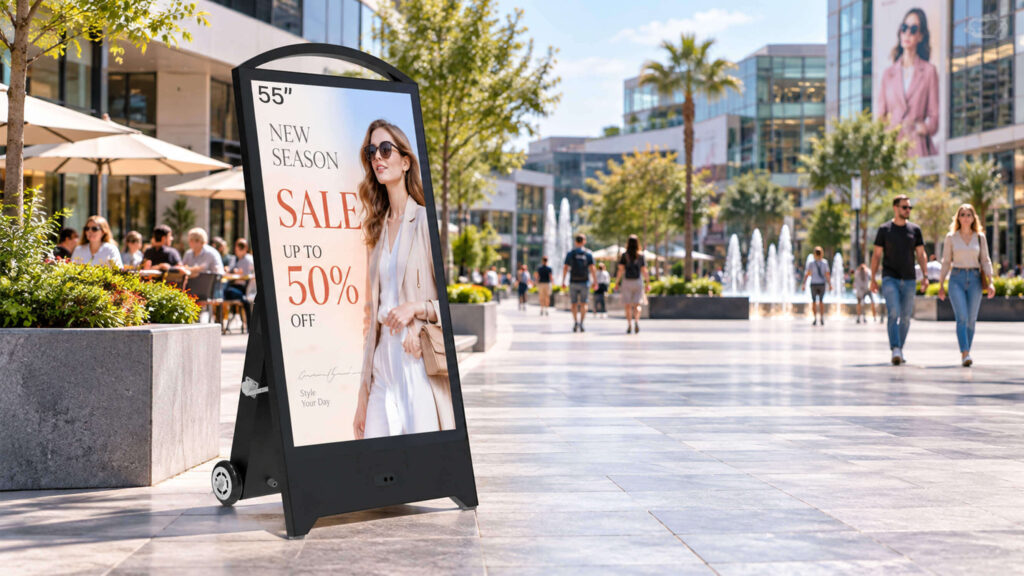
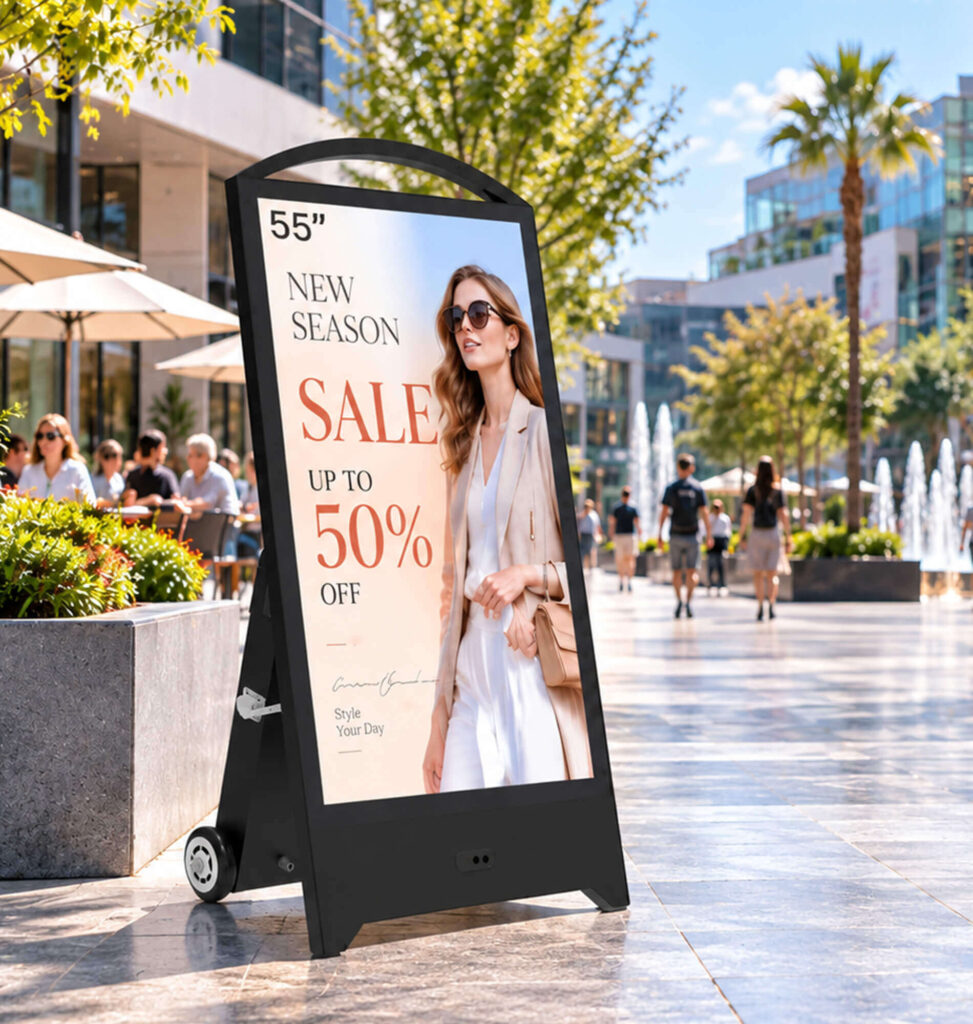
A 55-inch digital A-frame sign is designed for businesses where visibility and attention are the top priorities.
It is commonly used in:
- shopping malls
- outdoor advertising areas
- large retail stores
- exhibitions
- public events
The main advantage of a larger display is its ability to attract attention from a greater distance.
A 55-inch screen gives businesses more space to create powerful visual content, including:
- product videos
- large promotional graphics
- brand campaigns
- detailed advertisements
This makes it especially valuable in environments where customers are moving quickly and there are many competing visual messages.
However, larger does not automatically mean better.
Before choosing a 55-inch digital A-frame, businesses should consider:
- Is there enough placement space?
- Can employees move the display easily?
- Does the content require a larger screen?
- Is the environment suitable for a larger investment?
A large display should solve a marketing challenge, not simply create a bigger appearance.
32″ vs 43″ vs 55″ Digital A-Frame Sign Comparison Chart
| Feature | 32″ Digital A-Frame Sign | 43″ Digital A-Frame Sign | 55″ Digital A-Frame Sign |
|---|---|---|---|
| Main Purpose | Close-range communication | Balanced commercial advertising | Maximum attention and visibility |
| Viewing Distance | Short distance | Medium distance | Longer distance |
| Portability | Excellent | Good | Moderate |
| Space Requirement | Small | Medium | Large |
| Investment Level | Lower | Medium | Higher |
| Content Capability | Basic promotions and messages | Videos, menus, advertisements | Large visual campaigns and premium content |
| Best Applications | Small stores, indoor areas | Restaurants, retail, events | Outdoor advertising, malls, large venues |
Recommended Digital A-Frame Sign Size by Industry
Different industries have different customer behaviors.
A restaurant needs customers to quickly understand menu options. A retail store needs to attract attention and encourage customers to enter. An exhibition booth needs to stand out among many competitors.
Therefore, the ideal digital A-frame size depends on the application.
| Industry / Application | Recommended Size | Why This Size Works Best |
|---|---|---|
| Restaurants & Cafes | 43″ (32″ for smaller spaces, 55″ for high traffic areas) | Provides enough space for menus, food images, and promotions while remaining easy to move |
| Retail Stores | 43″–55″ | Larger screens help attract passing customers and showcase products visually |
| Hotels & Hospitality | 32″–43″ | Customers usually view information from a closer distance, making compact displays effective |
| Shopping Malls & Commercial Centers | 55″ | Larger spaces require stronger visibility to compete with surrounding advertisements |
| Trade Shows & Exhibitions | 43″–55″ | Helps brands attract visitors and display promotional videos |
| Outdoor Events | 55″ | Longer viewing distances require greater visual impact |
| Small Businesses & Boutiques | 32″–43″ | Fits limited spaces while providing effective customer communication |
Beyond Screen Size: Other Factors That Affect Digital A-Frame Performance
Choosing the right size is important, but it is not the only factor that determines whether a digital A-frame sign performs well.
Brightness Matters, Especially Outdoors
A larger screen does not guarantee better visibility.
Outdoor environments introduce challenges such as sunlight reflection and changing lighting conditions.
For outdoor applications, businesses should also evaluate:
- brightness level
- anti-glare technology
- weather protection
- operating temperature
A smaller but brighter display can sometimes provide better results than a larger screen with poor visibility.
Content Design Should Match Screen Size
The amount and type of content also influence the ideal display size.
A simple message like:
“50% OFF TODAY”
does not require the same screen space as:
- a restaurant menu
- product demonstration video
- advertising campaign
The more visual content a business wants to display, the more valuable a larger screen becomes.
Consider Daily Operation and Mobility
Digital A-frame signs are often moved every day.
Before selecting a size, businesses should consider:
- transportation requirements
- storage space
- installation location
- staff operation
A larger display may attract more attention, but a smaller display may provide better operational convenience.
Final Recommendation: Which Digital A-Frame Size Should You Choose?
There is no universal best digital A-frame size.
The right choice depends on your customer journey.
Choose a 32-inch digital A-frame sign when:
- customers view the display from a close distance
- space is limited
- portability is important
Choose a 43-inch digital A-frame sign when:
- you need a versatile commercial solution
- you want a balance between visibility and mobility
- the display will be used for restaurants, retail, or events
Choose a 55-inch digital A-frame sign when:
- attracting attention from a distance is the priority
- the display is used outdoors or in large spaces
- maximum visual impact is required
The best digital A-frame sign is not the biggest one available.It is the one that allows your customers to see your message clearly, understand it quickly, and take action.Choosing the right screen size helps businesses create more effective digital signage experiences and achieve better value from their investment.
Frequently Asked Questions About Digital A-Frame Signs
1. Can digital A-frame signs be used outdoors in full sunlight?
Yes, but you need a display specifically built for outdoor environments. High ambient light requires a screen brightness of at least 1,500 to 2,500 nits, along with anti-glare glass and weatherproof (IP65) protection to remain readable and safe from moisture.
2. How long does the battery last on a portable digital A-frame sign?
Battery life typically ranges from 8 to 14 hours on a full charge, depending on screen brightness, video content, and battery capacity. Most commercial models feature high-capacity lithium iron phosphate (LiFePO4) batteries designed for full-day operation, and many support quick-swappable battery modules or integrated charging ports for easy overnight recharging.
3. How do I update content on a digital A-frame sign?
Most modern digital A-frame displays support two main update methods: Plug-and-Play via USB drive for quick offline updates, or cloud-based Content Management Systems (CMS) via Wi-Fi/4G, which allow you to schedule and change promotions remotely from anywhere.
4. Are 43-inch digital A-frames better than 55-inch displays for trade show booths?
For standard 10×10 ft exhibition booths, a 43-inch display is usually ideal because it doesn’t block foot traffic or crowd product displays. However, if you have a large island booth or high ceilings, a 55-inch model will provide much better long-range visibility to attract visitors from across the aisle.