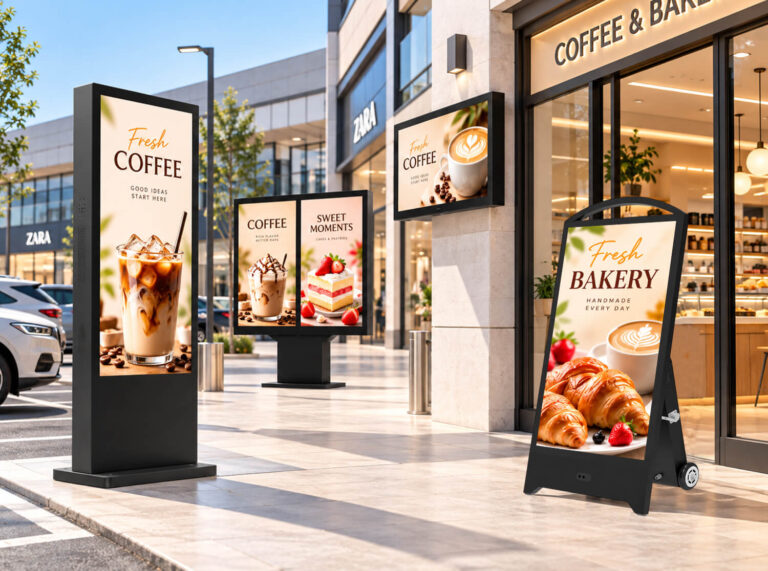

The digital signage industry has moved decisively toward flexible, non-permanent installations over the past several years. The global digital signage market was valued at roughly $31 billion in 2025 and is projected to reach approximately $58 billion by 2033, according to Grand View Research — growth increasingly concentrated in outdoor and retail deployments where businesses need displays that can be relocated, redeployed, or scaled across sites without construction timelines. On the demand side, that investment is paying off at the point of sale: a 2024 OAAA / Harris Poll study found that 76% of consumers who recently viewed a digital out-of-home ad took a subsequent action — visiting a business, making a purchase, or engaging with the brand.
Buyers evaluating portable digital signage, however, typically default to two filters — screen size and price — because both are visible and easy to compare across vendors. Neither is the variable that actually determines whether a unit performs once it’s deployed. This digital signage buying guide works through what portable digital signage actually is, the seven factors that determine fit, the features worth paying for versus the ones that are marketing filler, realistic cost ranges, and a checklist to run before requesting a quote.
What Is Portable Digital Signage and Who Needs It?
Portable digital signage refers to self-contained digital displays — screen, media player, stand, and power system built into one unit — designed to be moved, repositioned, or relocated without the electrical trenching, permitting, or structural mounting that a fixed installation requires. It sits between two other categories buyers often confuse it with: handheld tablets (too small for most commercial visibility needs) and fixed digital signage (permanently mounted, wired into building infrastructure, and immovable without a construction crew).
What Makes a Digital Signage Display Portable?
Three characteristics define portability in a commercial-grade unit, and a display missing any one of them is portable in name only:
- A self-contained power system — either an integrated battery or a design that runs on standard outlet power without dedicated wiring — so the unit isn’t tethered to a fixed electrical connection
- A mobile base — casters, a weighted A-frame stand, or a lightweight enclosure that one or two people can reposition without machinery
- Independent operation — content stored or streamed to the unit directly, without requiring a hardwired connection to an in-store network or point-of-sale system
A display that requires a dedicated electrical circuit, is bolted to a wall or post, or depends on a wired connection to function is a fixed installation regardless of how the vendor markets it.
Which Businesses Can Benefit From Portable Digital Signage?
Portable digital signage is specified most often by businesses with one of three operating patterns:
- Multi-location or seasonal operators — retail chains, franchise groups, and restaurant operators rotating promotional content across several sites without installing a unit at each one permanently
- Temporary or event-driven venues — pop-up storefronts, construction-phase openings, trade shows, and outdoor events where a display needs to go up and come down within a defined window
- Sites without finalized electrical infrastructure — new developments, leased outdoor space, and locations where trenching for a fixed unit isn’t cost-justified for the deployment timeline
Businesses with a single, permanent, high-traffic location where the unit will never move are frequently better served by a fixed installation — a distinction covered in more depth in our fixed vs. portable comparison.
7 Key Factors to Consider When Choosing Portable Digital Signage
1. Where Will You Use the Display?
Deployment environment determines nearly every downstream specification for portable digital signage. Before comparing units, define:
- Indoor, outdoor, or both — outdoor use requires weather sealing and higher brightness that indoor-only units don’t carry
- Movement frequency — daily repositioning, seasonal rotation across a handful of sites, or a one-time placement that stays put for months
- Site power — confirmed electrical access, no access, or intermittent access across multiple deployment locations
These three answers eliminate entire categories of units before screen size or price ever enter the conversation.
2. What Screen Size Is Right for Your Viewing Distance?
Screen size for portable digital signage should be set by viewing distance and ambient visual competition, not budget:
- Under 50″ — close-range viewing (queue lines, counter zones, narrow walkways) where people pass within 6–10 ft
- 50″–65″ — mid-range viewing across parking lots or wider walkways, competing with adjacent signage
- 65″ and above — long-range viewing from vehicles or across plazas, needing to register from 30+ ft away
Undersizing relative to approach distance is the most common specification error in portable deployments — more common than brightness or resolution shortfalls, and more expensive to correct after installation since it typically requires a full unit swap.
3. How Bright Should Portable Digital Signage Be?

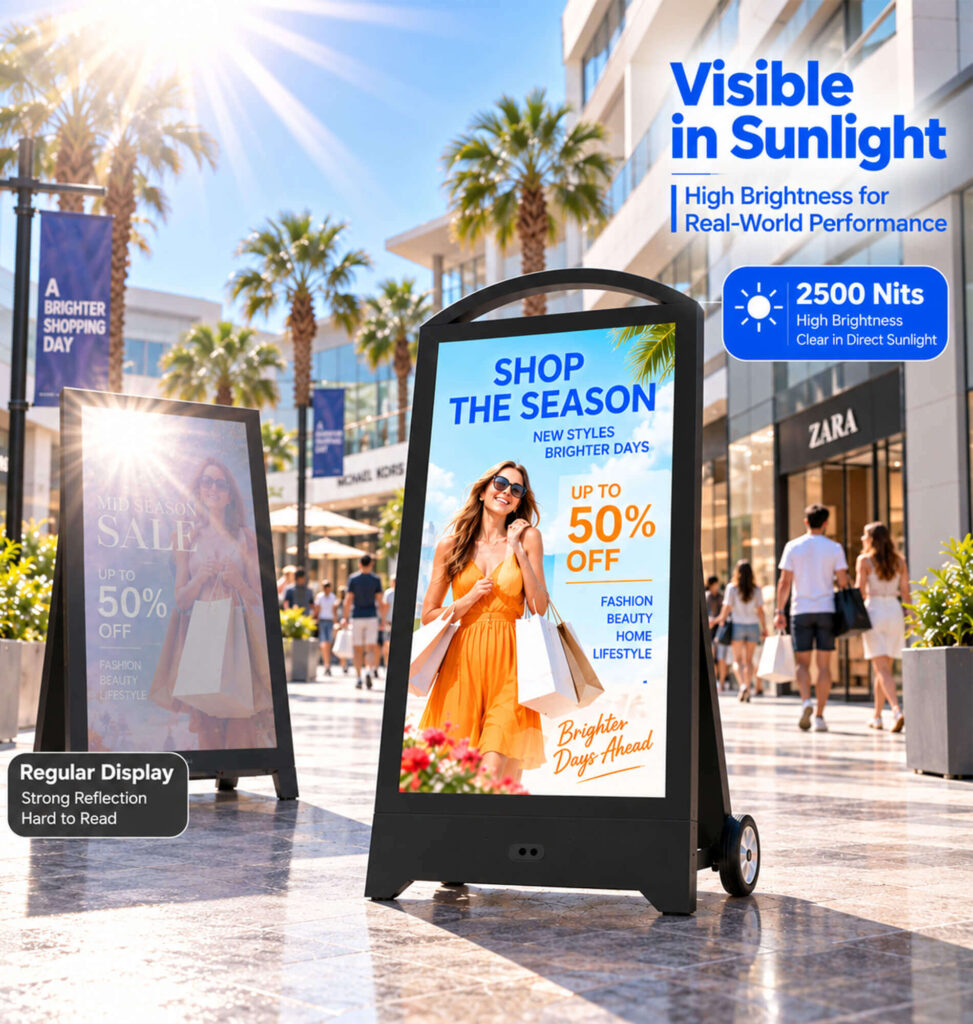
Indoor-rated panels typically run 300–500 nits, which becomes unreadable in direct sunlight. Outdoor portable digital signage intended for daylight visibility should specify at least 1,500 nits for shaded or overcast conditions, and 2,500 nits or higher for direct, unobstructed sun exposure. Requesting the manufacturer’s nit rating under direct sunlight testing — not the panel’s peak lab rating — avoids a common gap between spec sheet and field performance.
4. Do You Need Battery-Powered Digital Signage?
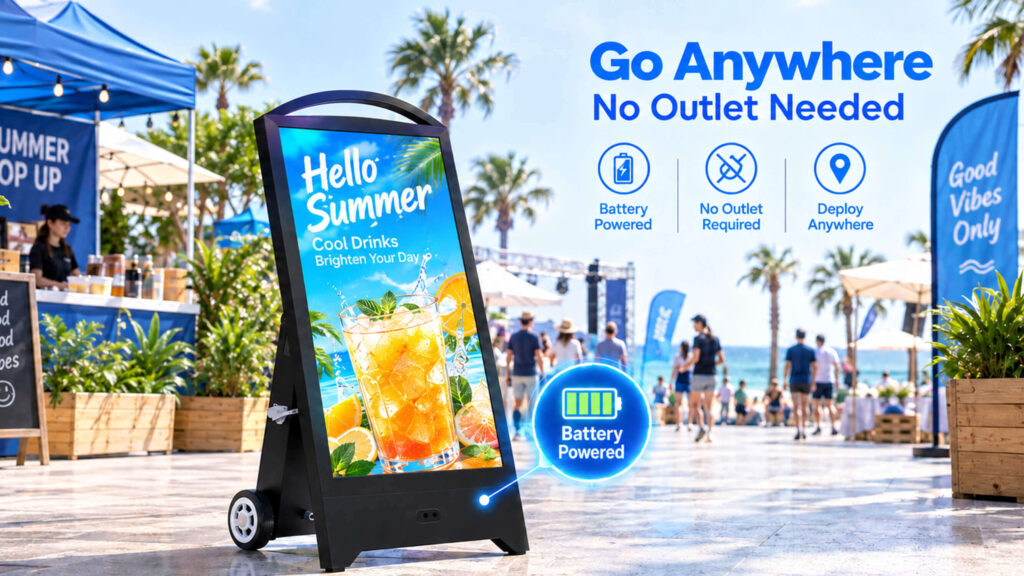
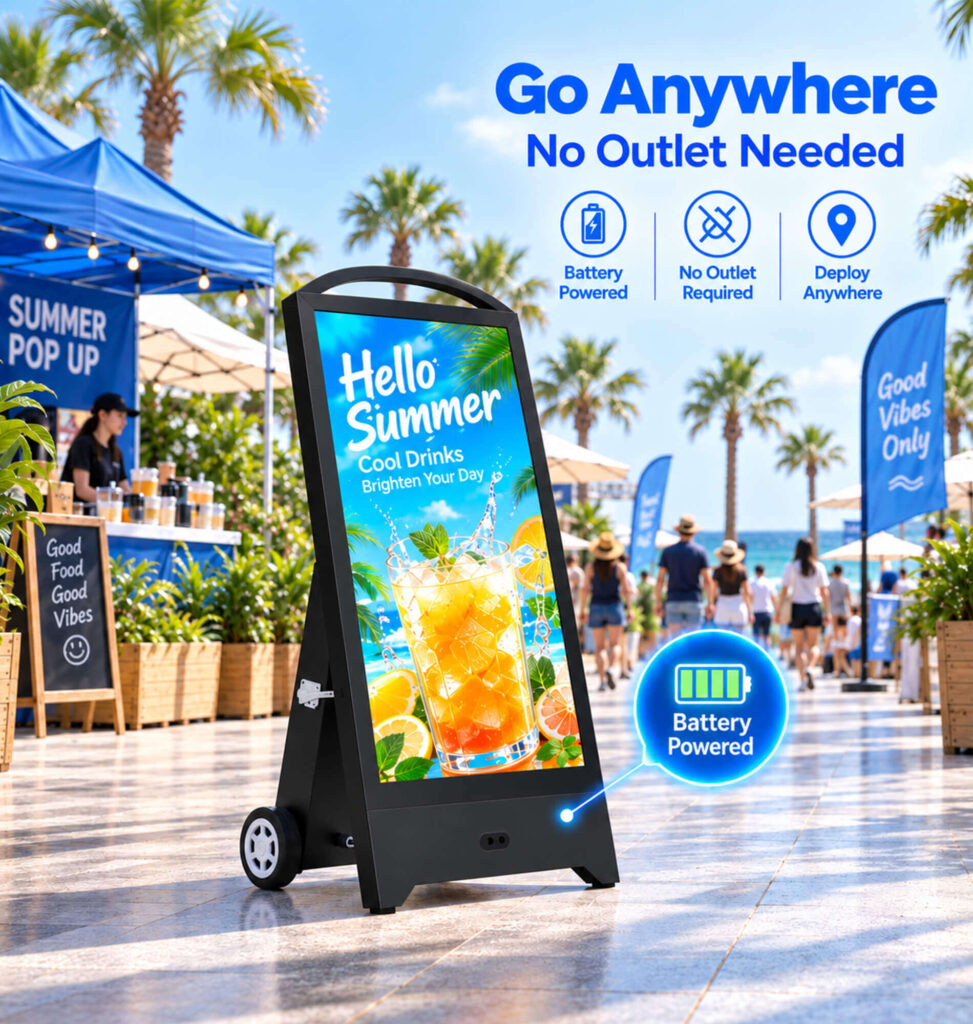
Power source should be determined by the site, not selected as a feature upgrade. Three site conditions require battery powered digital signage:
- No electrical infrastructure exists at the display point (temporary lots, event grounds, pre-buildout storefronts)
- Electrical trenching or permitting is technically possible but its cost or timeline exceeds the deployment schedule
- The unit needs to alternate between powered and unpowered locations within a single operating cycle
Where none of these apply and the unit will remain adjacent to an existing power source indefinitely, mains power is the lower-maintenance choice — it removes battery replacement cycles and charge-level monitoring from the operating plan entirely. Any battery pack specified for commercial deployment should also carry certification to UL 2054 (household and commercial battery packs) or the international equivalent IEC 62133-2, which most procurement and facilities teams will ask for before approving an installation.
5. How Important Are Wheels, Folding, and Portability?
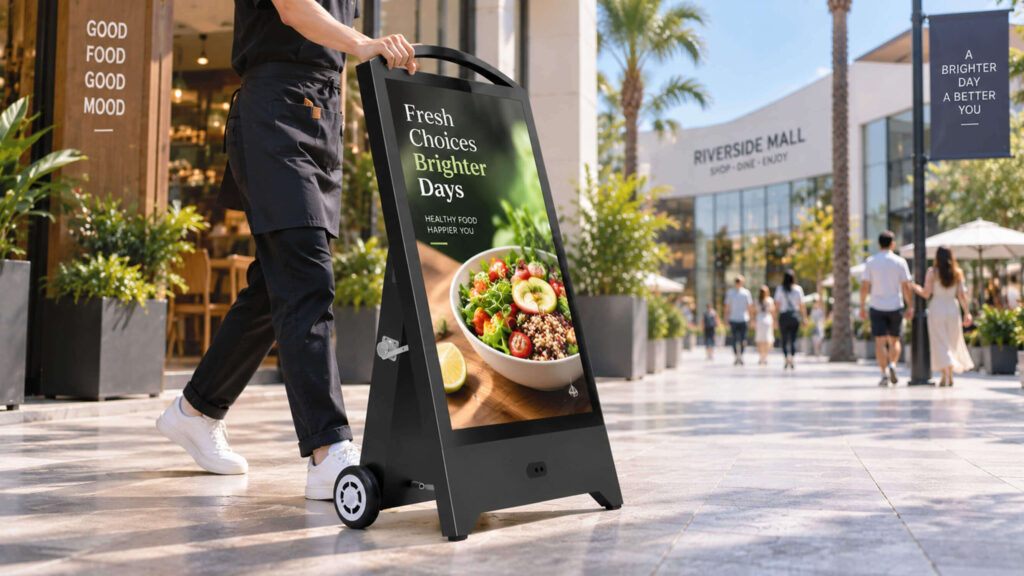
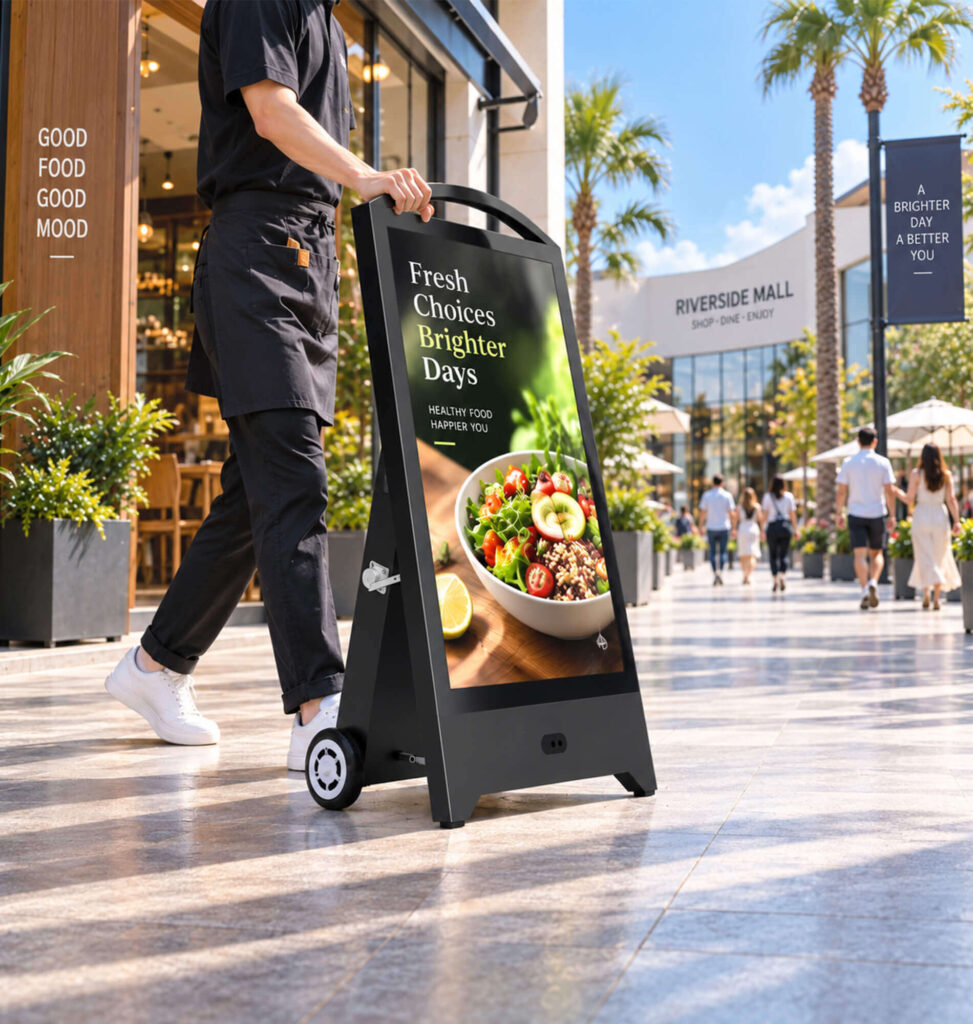
“Portable” covers a range of movement frequencies, and each implies a different physical design priority:
| Movement frequency | Design priority |
|---|---|
| Daily (moved in/out of storage each business day) | Low center of gravity, single-person handling, locking casters |
| Weekly to seasonal (rotated across a small set of fixed points) | Balance between mobility and screen size |
| Occasional (relocated every several months) | Screen size and battery capacity prioritized over ease of movement |
Rolling portable digital signs — units built around locking caster bases for single-person daily repositioning — are specified for the first category only. Applying the same mobile base to a unit meant to sit in one place for a season adds mechanical complexity with no corresponding benefit.
6. What Level of Weather Protection Do You Need?
For any unit that will sit outdoors unattended, an IP65 rating is the practical minimum — full protection against dust ingress and resistance to low-pressure water jets from any direction. Units deployed in coastal, high-humidity, or heavy-precipitation regions should be evaluated against IP66 for stronger jet resistance. IP ratings apply to the enclosure as tested, not to the unit as marketed — requesting the specific test report by rating body is a reasonable procurement ask, and one that separates units genuinely engineered for outdoor use from indoor units marketed with an outdoor-adjacent name.
7. How Will You Manage and Update Your Content?
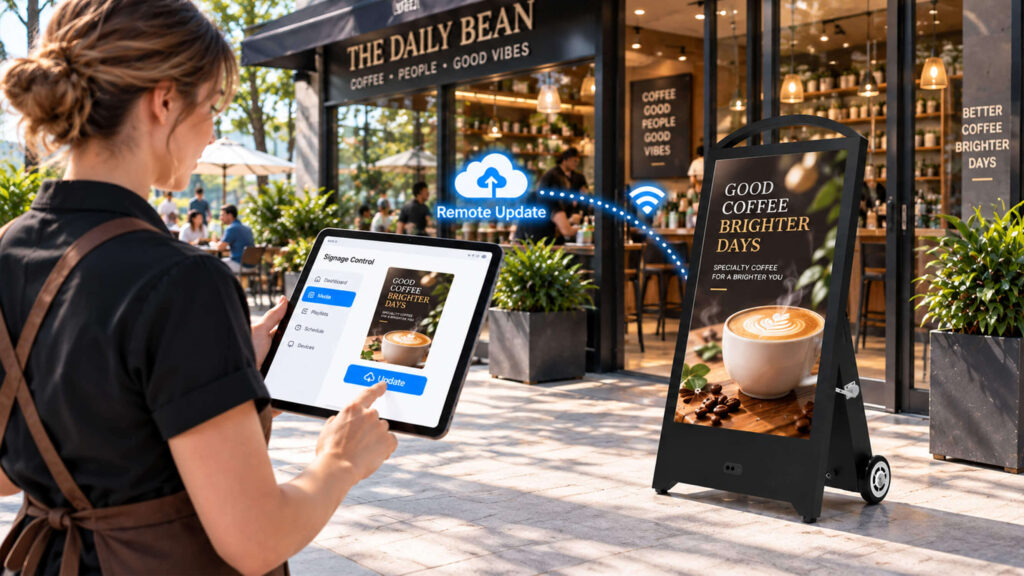
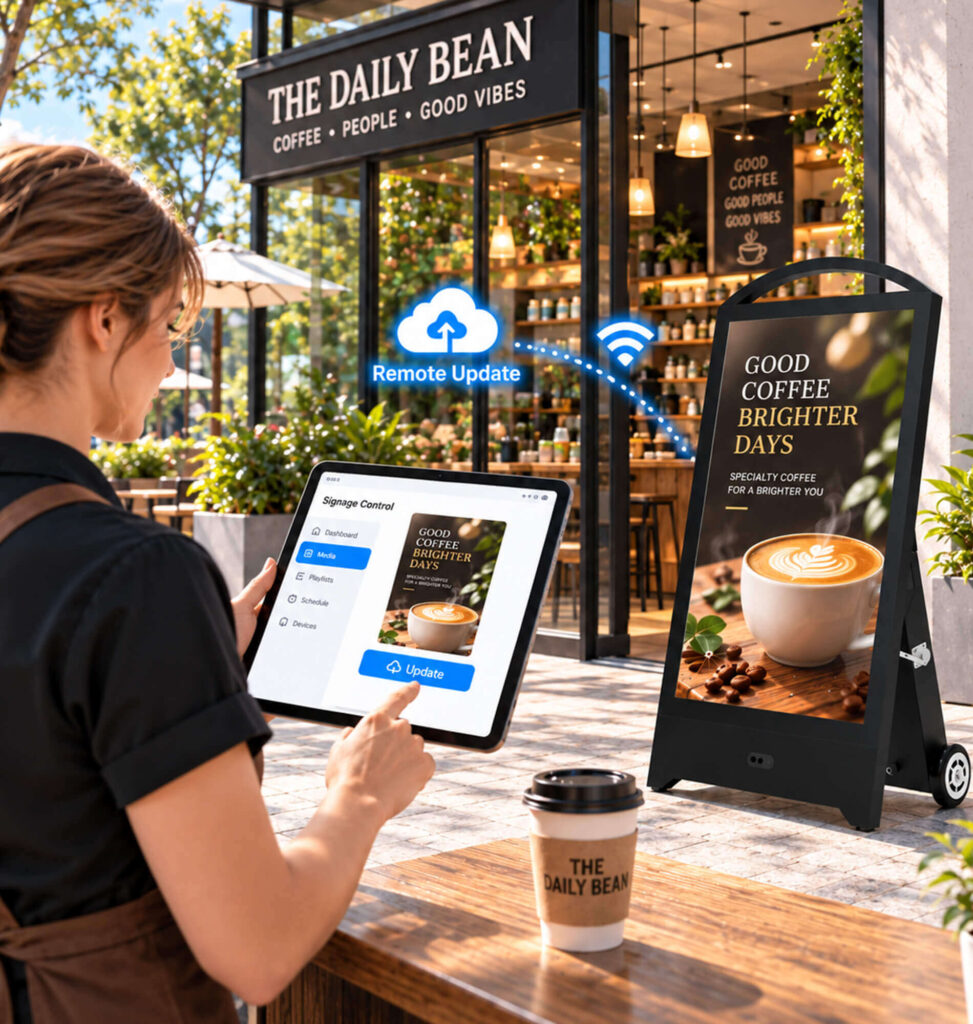
Content management is frequently evaluated last, after the hardware decision is already made — which is backward, since it determines day-to-day usability more than any single hardware spec. Confirm before purchase:
- Update method — Wi-Fi/cellular remote push versus manual USB updates on-site, which matters considerably for multi-location operators
- Scheduling — whether content can be scheduled in advance (daypart promotions, rotating seasonal messaging) or must be manually swapped
- User access — whether non-technical staff can update content without vendor involvement, or every change requires a support ticket
A unit with excellent hardware specs and a content management system that requires a technician for every update creates an ongoing operational cost that doesn’t show up in the initial quote.
Portable Digital Signage Features You Actually Need
Vendor spec sheets for portable digital signage often list features that sound valuable but rarely affect field performance, alongside a smaller set that consistently do. Worth prioritizing:
- Automatic brightness adjustment — sensors that scale luminance to ambient light, extending battery life without manual intervention
- Remote content management — covered above, but worth restating as a priority rather than an afterthought
- Certified battery safety — UL 2054 or IEC 62133-2, not a manufacturer’s internal claim
- Verified IP rating with a test report, not a marketing label
Worth deprioritizing unless a specific use case demands it: touchscreen capability (adds cost and failure points for content that’s typically one-way promotional messaging), higher resolution than the viewing distance requires, and proprietary content software that locks a business into a single vendor’s update workflow.
Portable Digital Signage vs. Fixed Digital Signage: Which Should You Choose?
The short version: portable digital signage fits sites with movement, uncertain power, or a defined deployment window; fixed digital signage fits a single permanent, high-traffic location with confirmed electrical infrastructure and no plan to relocate. Total cost of ownership over multiple years can favor either option depending on how often a unit will actually move — a portable unit redeployed across five seasonal locations is typically far more cost-effective than five separate fixed installations, while a single storefront that will never move often gets better long-term value from a fixed unit with no battery replacement cycle to manage. For a full breakdown of this decision, including a side-by-side cost and durability comparison, see our complete portable vs. fixed digital signage comparison.
How Much Does Portable Digital Signage Cost?
A complete cost comparison for portable digital signage should include three line items, not just the unit price:
| Cost category | What it includes |
|---|---|
| Base unit | Display panel, stand, enclosure |
| Power infrastructure | Battery packs and charging equipment, or trenching/permitting for mains power |
| Mobility hardware | Casters, locking mechanisms, anti-theft hardware appropriate to the deployment environment |
Entry-level portable units with smaller screens and standard battery capacity typically represent the lowest upfront cost but the narrowest use case. Mid-range units balance screen size and battery capacity for weekly or seasonal rotation. Premium configurations — larger screens, extended battery capacity, or mains-and-battery hybrid power — cost more upfront but often reduce total cost over a multi-year deployment by eliminating the need for a second unit or a power infrastructure retrofit. A configuration with a lower base price and unbudgeted power infrastructure costs can exceed the total cost of a higher base price with battery power built in from the outset. Request itemized quotes broken into these three categories, not a single bundled figure.
How to Choose Portable Digital Signage Based on Your Business
- Franchise or multi-location retail testing a new market: prioritize a mid-range configuration with strong battery life and remote content management, so one unit can be evaluated before a multi-site order is placed
- Restaurant or QSR operator with seasonal or pop-up locations: prioritize battery powered digital signage with an IP65+ rating and a rolling base for daily repositioning between service windows
- Event or trade show organizer: prioritize lightweight mobility hardware and fast setup/breakdown over maximum screen size, since deployment windows are typically measured in hours, not months
- Property developer or leasing office with pre-buildout sites: prioritize battery capacity and weather protection, since the unit may need to operate unattended outdoors for extended periods before permanent infrastructure exists
- Single-location business with a permanent, high-traffic storefront: revisit whether a fixed installation is the better long-term fit before defaulting to portable
Portable Digital Signage Buying Checklist
Before requesting a quote, confirm the following in order — each answer eliminates a category of options rather than adding preference-based filters:
- Power at the site: confirmed available / not available / intermittent → determines whether battery powered digital signage is mandatory
- Movement frequency: daily / weekly-seasonal / occasional → determines base and caster design
- Approach distance: measured, not estimated → determines screen class
- Climate exposure: shaded / direct sun, coastal / inland, dry / high-precipitation → determines minimum luminance and IP rating
- Content management needs: remote push vs. manual updates, and who on staff will manage it
- Deployment scope: single-site pilot / multi-site standard → determines whether to optimize for lowest unit cost or for consistency across a specified configuration
- Total cost comparison: itemized base unit, power infrastructure, and mobility hardware — not a single bundled number
Final Thoughts
The correct portable digital signage configuration is the one whose location, mobility pattern, power source, and content workflow were derived from actual site conditions — not the configuration with the most features relative to price. Running a deployment through the factors and checklist above before requesting a quote is what determines whether a unit sees consistent weekly use or sits idle in storage after its first season.
FAQ
Does portable digital signage need a permit to operate outdoors?
Permit requirements vary by municipality and by whether the unit is classified as a temporary structure, a sign, or an electrical installation. Battery powered digital signage generally faces fewer permitting hurdles than mains-powered installations requiring new electrical service, but local sign ordinances on placement, size, and illumination still apply regardless of power source. Confirming requirements with the local planning or code enforcement office before deployment avoids a delay after the unit has already arrived on site.
How long does a battery charge last on a typical unit?
Runtime depends heavily on brightness setting and ambient temperature, not just battery capacity. A unit rated for 10–12 hours of continuous runtime under moderate brightness may deliver considerably less at maximum brightness in direct summer sun, since higher brightness draws more power and hot ambient temperatures reduce battery efficiency. Requesting runtime figures tested at the brightness level the deployment will actually use gives a more reliable planning figure than the manufacturer’s best-case rating.
Can one portable digital signage unit be used both indoors and outdoors?
Technically yes, but not without trade-offs. A unit specified with an IP65+ rating and a high-nit outdoor panel will typically be heavier and more expensive than an indoor-only equivalent, and indoor use doesn’t require either specification. For businesses genuinely alternating between both environments, this is usually still more economical than purchasing separate indoor and outdoor units — but it’s a deliberate trade-off, not a default assumption.
What is the realistic lifespan of a portable outdoor unit?
With proper specification against the factors above — appropriate IP rating for the climate, adequate luminance margin rather than running at maximum brightness continuously, and a battery system with pack-level safety certification — a well-specified unit typically remains serviceable for 5–7 years of regular outdoor use before panel or battery degradation becomes the limiting factor. Undersized or under-rated units in demanding climates often show meaningful performance loss well before that point.
Have a specific site condition — power access, movement frequency, or approach distance — you’d like matched to a configuration? Contact our team for a tailored recommendation →https://yinglux.com/outdoor-portable-digital-signage/