If you’re comparing quotes and wondering why one outdoor digital signage price is triple another, you’re not alone. Buyers evaluating portable digital signage cost for the first time are often surprised at how wide the spread can be — two units that look nearly identical in a spec sheet PDF can land tens of percent apart once brightness, battery, enclosure grade, and software terms are factored in. That spread isn’t random; it reflects real engineering and manufacturing trade-offs that determine how a unit performs in the field over its full lifespan, not just on day one.
This guide breaks down exactly what drives outdoor digital signage price in 2026 — screen size, brightness, battery system, IP rating, mobility hardware, software licensing, and warranty structure — so you can read a quote line by line instead of anchoring on a single bottom-line number. We’ll also cover the hidden costs that rarely appear on the first quote but materially affect total cost of ownership, and give you a framework for requesting an apples-to-apples comparison from multiple suppliers.
If you are new to this technology, start with our [complete overview of portable outdoor digital signage] to understand the core hardware features before diving into pricing.
Why Digital Signage Pricing Varies So Much Between Vendors
Before breaking down individual cost drivers, it helps to understand why digital signage pricing is so inconsistent across the market in the first place. Three structural factors are at play:
- Component sourcing tier. LCD/LED panels, drivers, and battery cells are sourced at different quality tiers. A-grade panels with tighter color and brightness tolerances cost more than B-grade or refurbished panels, even when the published nit rating looks identical on paper.
- Manufacturing scale and vertical integration. Manufacturers who design and assemble in-house (rather than white-labeling a third-party chassis) can control cost more precisely and typically offer better cost-per-nit and cost-per-year-of-warranty ratios.
- Regional cost structures. Import duties, freight mode (sea vs. air), and local installation labor rates all shift the landed cost of the same physical unit depending on where it’s deployed.
Understanding these structural drivers is what separates a buyer who can negotiate intelligently from one who is simply comparing bottom-line numbers.
What Determines Outdoor Digital Signage Price?
Digital signage pricing isn’t a single number — it’s the sum of several engineered components, each of which scales cost independently. Understanding each one helps you avoid overpaying for specs you don’t need, or underspending on ones that actually matter for your use case.
1. Screen Size
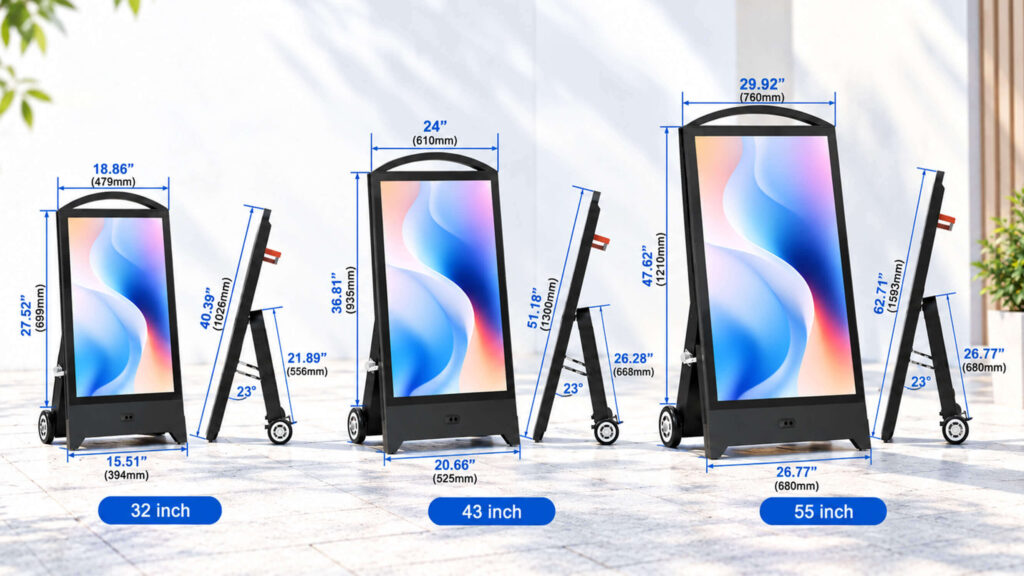
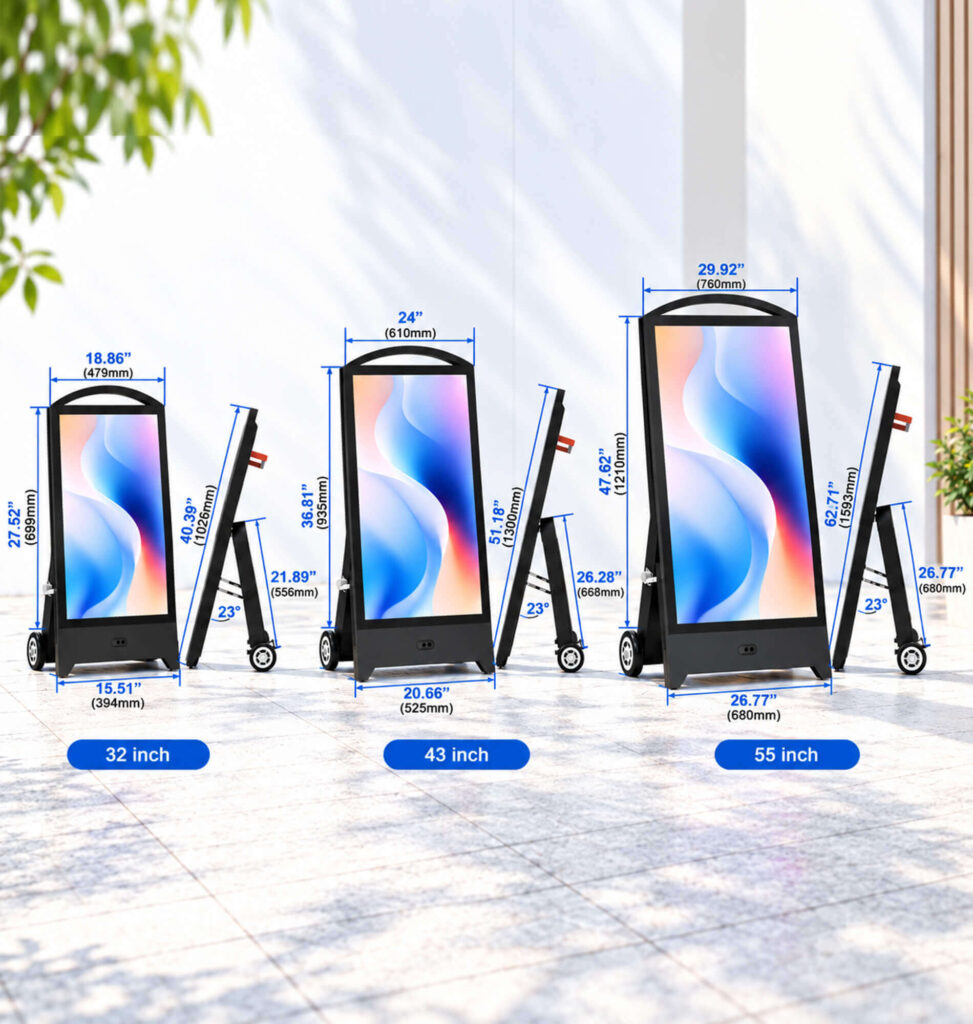
Larger panels cost more, both in raw LCD/LED material and in the frame, weight, and stand engineering required to support them safely outdoors, where wind load becomes a real structural consideration. A 32″ unit and a 49″ unit from the same product line can differ in price by 40–60%, and the gap widens further once you factor in the heavier-duty base and counterweight system needed to keep a larger, top-heavier screen stable in outdoor conditions. Larger screens also typically require more powerful backlighting to hit the same brightness-per-square-inch, compounding the cost difference beyond what panel size alone would suggest.
2. Brightness (Nits) and Sunlight Readability
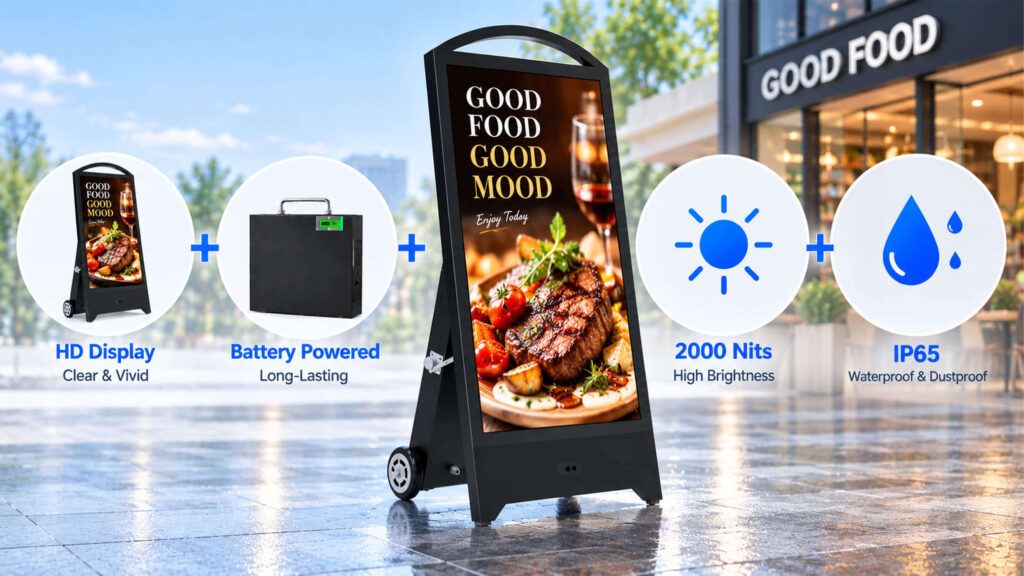
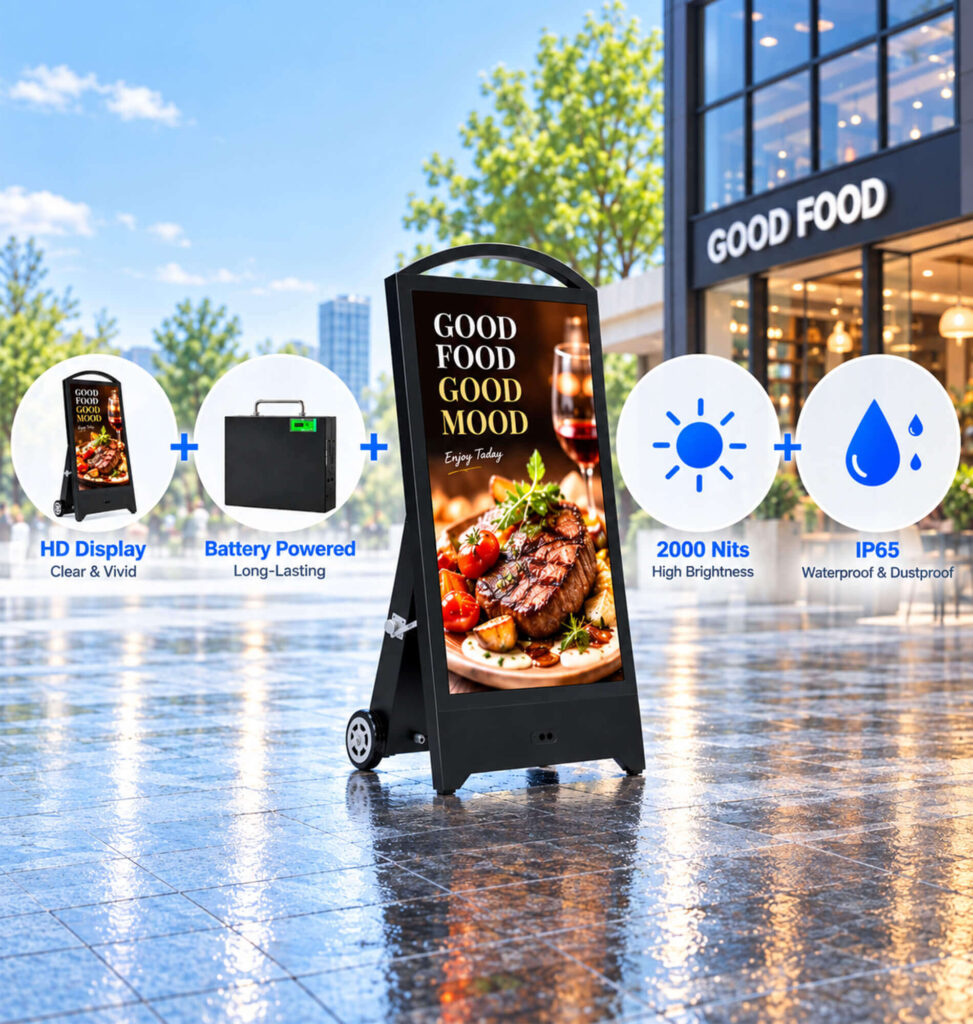
Outdoor-readable displays need significantly higher brightness than indoor screens — typically 2,500 to 4,000+ nits versus 300–500 nits for a standard indoor commercial display. High-brightness panels require more powerful LED backlighting arrays, more robust thermal management (to prevent heat damage at sustained high output), and tighter panel calibration — all of which add manufacturing cost. As a rough industry rule of thumb, cost does not scale linearly with nits: pushing from 2,500 to 3,500 nits typically adds a proportionally larger cost increment than the jump from 1,500 to 2,500, because it pushes components closer to their thermal and electrical limits.
3. Battery Capacity & Runtime
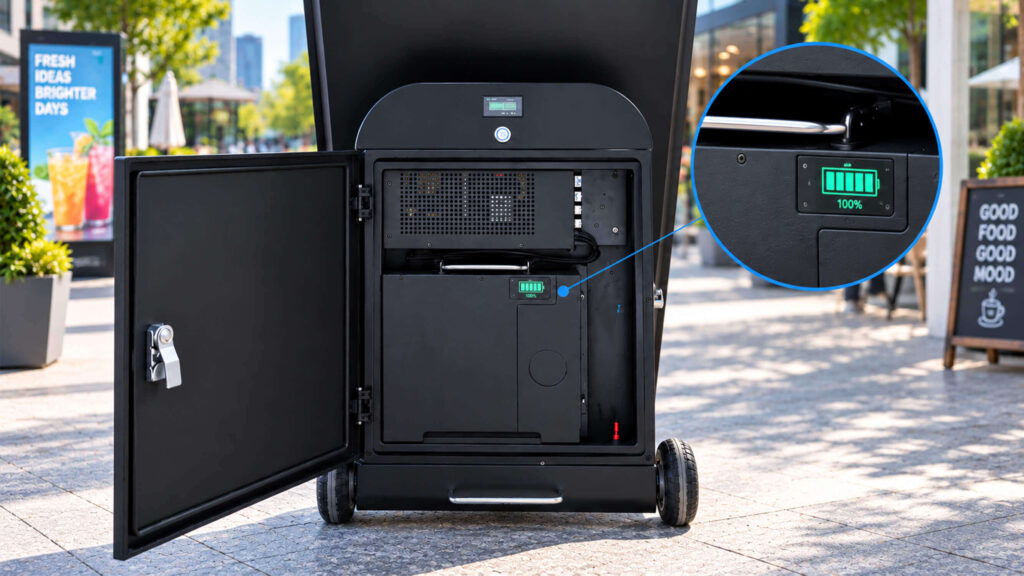
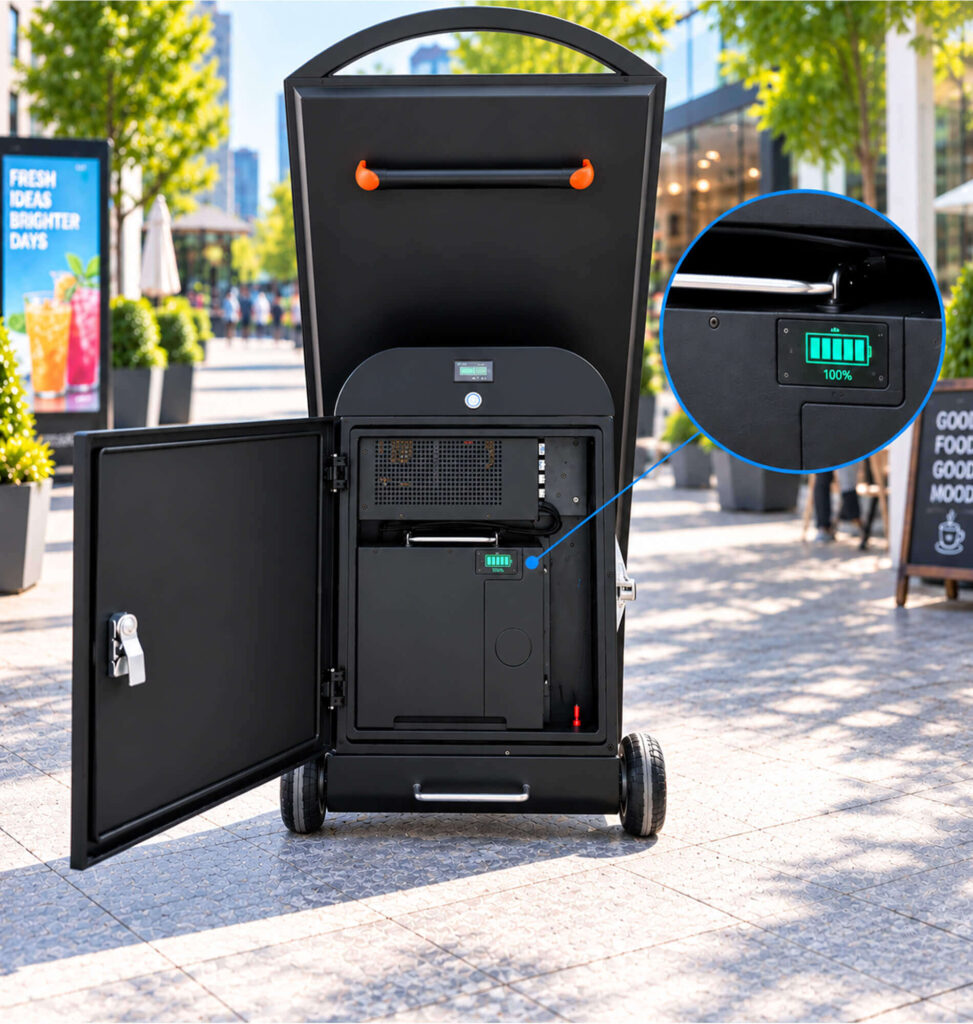
Battery-powered digital signage adds cost compared to plug-in-only units — the battery cells, battery management system (BMS), and reinforced housing to protect them all add to the bill of materials. However, it frequently reduces total project cost by removing the need for electrical trenching, conduit, or a licensed electrician at the deployment site, which can be one of the largest hidden costs of a “cheaper” plug-in-only unit. Runtime requirements (a few hours per charge vs. all-day, multi-day operation) directly affect battery pack size, and therefore weight, cost, and charging infrastructure needs.
4. Weatherproofing (IP Rating)

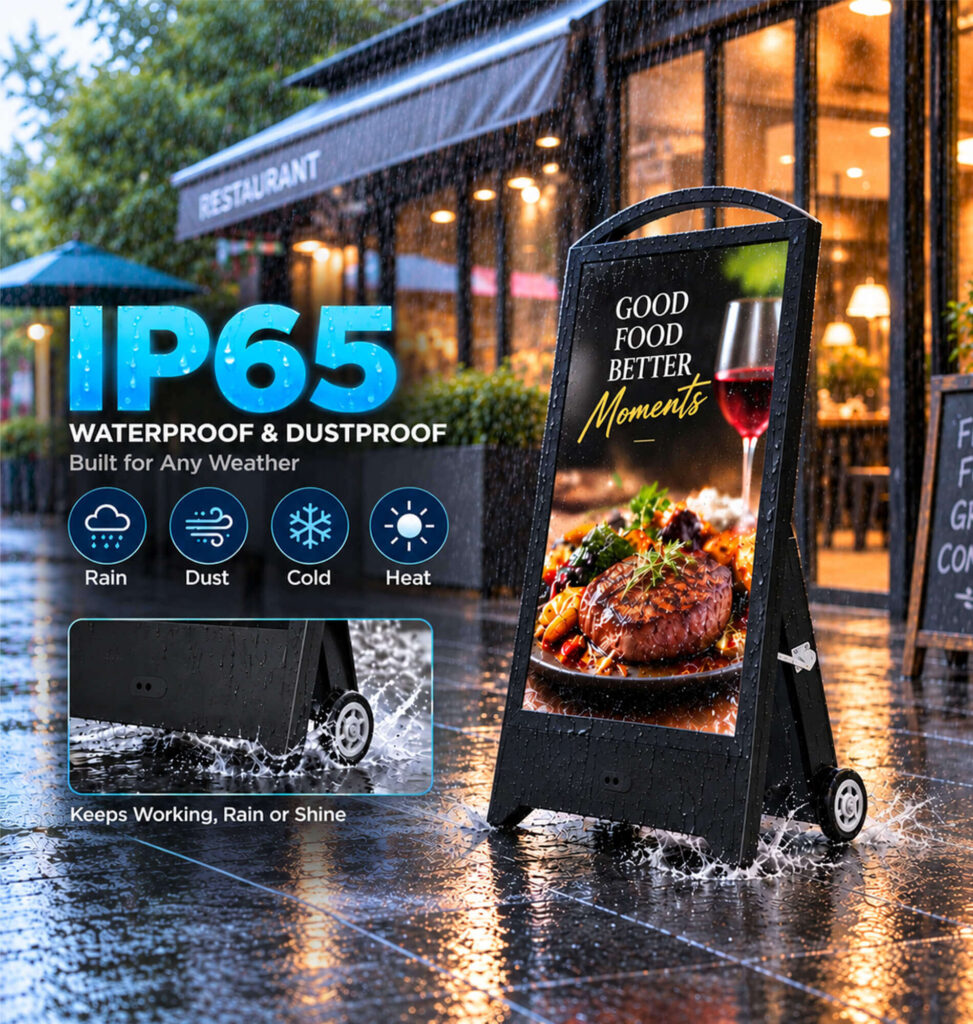
An IP65-rated enclosure that protects against dust ingress and low-pressure water jets from any direction costs meaningfully more than a basic outdoor-resistant casing, due to sealed connectors, gasketed panel seams, and drainage engineering. This is not a cosmetic spec — units without genuine IP65 protection are prone to internal condensation, connector corrosion, and premature panel failure within 12–24 months in humid or coastal climates, which erases any upfront savings.
5. Mobility Features
Wheels, locking casters, and a low center of gravity for outdoor stability all add manufacturing cost but reduce labor cost at deployment — no rigging crew or dedicated installation visit is required to relocate the unit between sites or store it seasonally. For businesses running seasonal, event-based, or multi-location deployments, this labor savings often outweighs the incremental hardware cost within the first one to two relocations.
6. Content Management Software (CMS)
Some vendors bundle CMS licensing into the unit price for the life of the hardware; others charge an ongoing subscription, which can add up to a meaningful fraction of the original unit cost over a multi-year deployment. Always ask explicitly whether digital signage pricing includes lifetime CMS access, cloud content scheduling, remote diagnostics, and software updates — or whether these are billed separately and, if so, at what renewal rate.
7. Warranty & Support
A 1-year warranty versus a 5-year warranty reflects real, quantifiable cost differences in component quality, factory burn-in testing, and the after-sales support infrastructure a manufacturer maintains. A longer warranty is generally a signal — not a guarantee, but a signal — that the manufacturer has enough confidence in component longevity to absorb failure risk over a longer window. This should be factored into any total cost of ownership comparison, not treated as a simple add-on line item.
Typical Price Ranges (2026)
| Screen Size | Typical Use Case | Approximate Price Range (USD) | Key Cost Drivers at This Size |
|---|---|---|---|
| 32″ | Small retail, pop-up events, single-entrance wayfinding | $1,149~$1,359 | Base battery pack, standard IP65 casing |
| 43″ | Retail, restaurants, exhibitions, mid-size venues | $1,299~$1,429 | Mid-tier brightness, reinforced stand |
| 49″+ | High-traffic outdoor locations, drive-thru approach lanes, large venues | $1,699~$1,849 | Max brightness tier, heavy-duty base, larger battery |
Note: Third-party market pricing varies widely by region, brand tier, and order volume. We recommend anchoring this table to Yinglux’s own published pricing or a request-a-quote CTA rather than estimated competitor figures, since publishing unverified numbers can mislead buyers and create SEO risk if figures go stale.
According to recent commercial display market data from industry benchmarks like the [Digital Signage Federation], outdoor hardware costs remain heavily influenced by panel brightness and thermal engineering.
Hidden Costs to Watch For
The unit price on a quote is rarely the full cost of ownership. Before signing, ask vendors directly about each of the following, since they’re the line items most often omitted from an initial quote:
- Shipping and export packaging. Crated, palletized export packaging for outdoor units is bulkier and heavier than standard retail packaging, and freight cost (especially by air) can be a significant fraction of unit cost for smaller orders.
- Setup and commissioning, not physical installation. Because these units are portable and self-contained (no drilling, wall-mounting, or electrical trenching required), there’s no traditional “installation” cost. What can still show up as a separate line item is network setup, CMS configuration, and initial content upload — the software side of getting the unit live, not the hardware side. Confirm upfront whether this is bundled into the unit price or billed as a separate remote/on-site service.
- Replacement battery cost over the unit’s lifespan. Lithium battery packs degrade over hundreds of charge cycles; ask what a replacement pack costs and how often it’s realistically needed under your intended usage pattern.
- CMS subscription renewal fees. A low upfront unit price paired with an expensive annual CMS renewal can end up costing more over five years than a higher upfront price with lifetime software access.
- Spare parts and repair turnaround. Ask what parts are stocked locally versus shipped internationally, and what the average repair turnaround time is — a long turnaround effectively means paying for signage that isn’t generating value while it’s in transit for repair.
How to Get an Accurate Quote
Because outdoor digital signage price depends on so many interacting variables, the fastest way to get an accurate, comparable number is to specify your requirements upfront rather than asking for a general price range. At minimum, provide:
- Target screen size and viewing distance
- Minimum brightness requirement based on your installation’s sun exposure
- Required daily runtime on battery, and whether AC charging will be available on-site
- Environmental conditions (coastal, high-humidity, extreme temperature, etc.) that inform the IP rating you need
- Whether you need CMS software included or already have a content management solution in place
- Deployment timeline and quantity, since order volume materially affects per-unit pricing
Providing these details upfront lets suppliers quote a fair, apples-to-apples price rather than a generic range — and it lets you spot immediately when a quote is unrealistically low because it’s quietly cutting one of these corners.
Conclusion
Portable digital signage cost is driven by seven interacting factors — size, brightness, battery, weatherproofing, mobility, software, and support — not by brand name alone. A supplier’s price only tells you part of the story until you know exactly which of these components you’re paying for and which corners, if any, have been cut to hit a lower number. Use this breakdown to ask sharper questions, request itemized quotes, and compare vendors on equal footing rather than on a single bottom-line figure.
Ready for a real number instead of a range? [Request a Quote — Outdoor PortableA-Frame Digital Signage ]