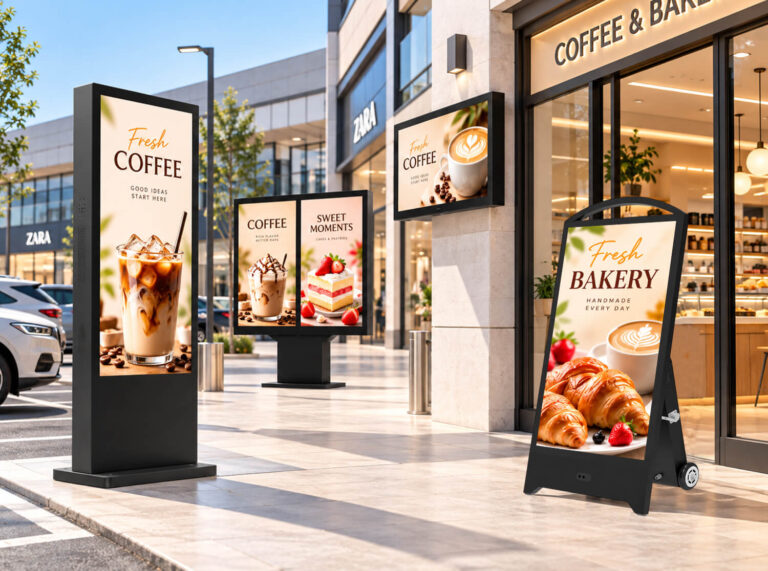
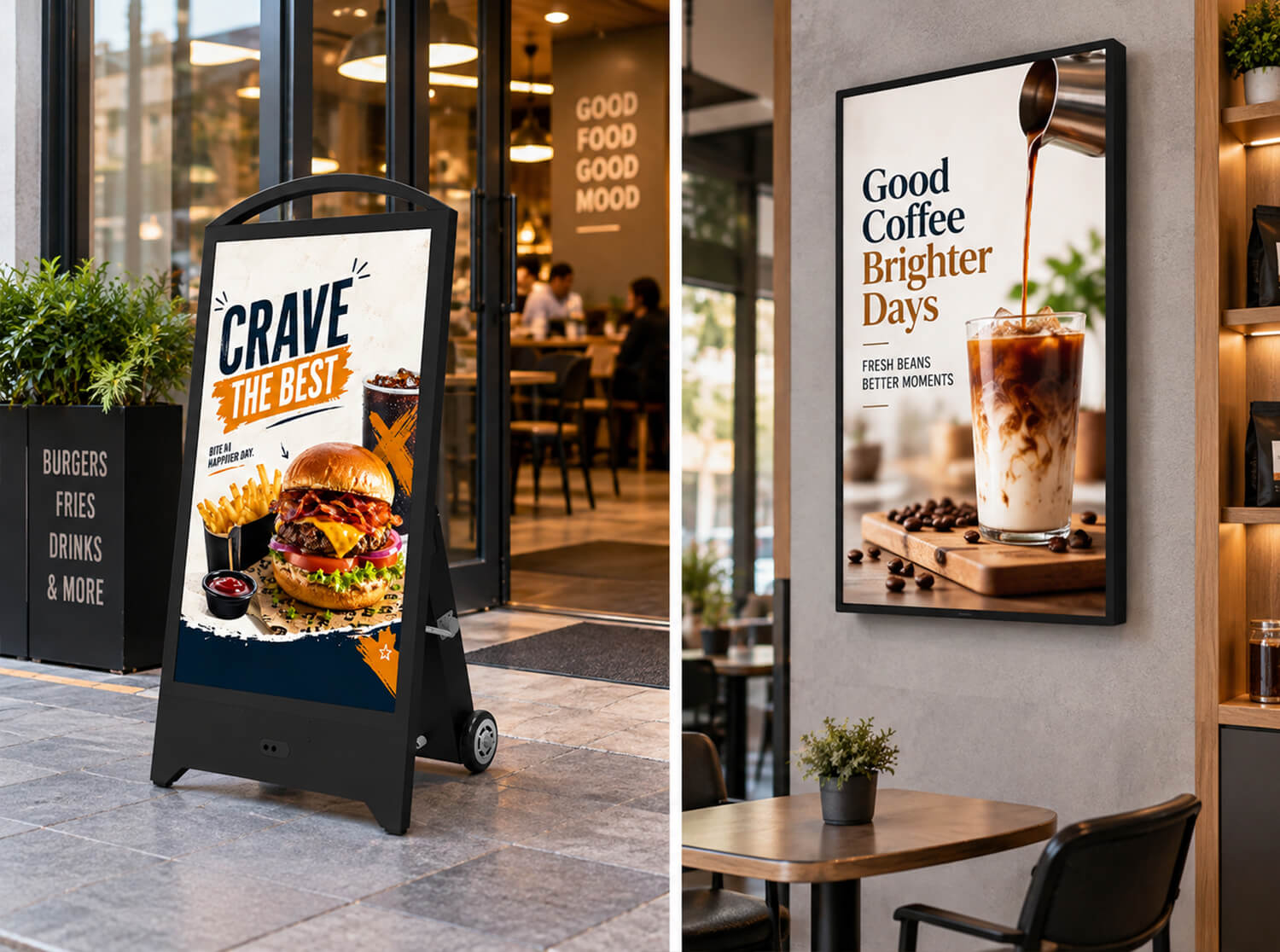
A regional restaurant group is opening its fifth location this quarter — this one inside a strip mall with a landlord who won’t approve any exterior wall penetrations before the lease renews in eight months. Marketing already has the promo content ready: a grand-opening countdown, a happy-hour loop, a QR code for the loyalty app. Facilities has a different problem: the last fixed installation at Location 3 took eleven weeks from signed quote to first power-on, once the structural engineer’s stamped drawing, the electrical permit, and the AHJ (authority having jurisdiction) inspection were all accounted for. This location doesn’t have eleven weeks.
The question on the table isn’t whether to use outdoor digital signage outside the storefront. It’s which kind — and whether the answer should be the same for every location the company opens next year. This is the exact decision point where most B2B buyers land when they search for outdoor digital signage: not confused about what digital signage is, but unsure whether their next outdoor digital signage purchase should be permanently mounted or portable, and what that choice actually commits them to in cost, code compliance, and lead time. Here’s how to work through it with the level of detail a facilities or procurement team actually needs.
Portable vs. Fixed: The Core Difference
Both outdoor digital signage formats are engineered to survive outdoors — sealed, IP-rated enclosures and sunlight-readable panels are table stakes on any legitimate exterior unit today. The difference isn’t durability. It’s how the display is anchored to the site, how it draws power, and — critically — which regulatory and structural obligations that anchoring triggers.
- Fixed (wall-mount, pole-mount, or in-ground) outdoor digital signage is bolted, trenched, or structurally anchored to a building or a permanent footing. In the U.S., this makes it a structural and electrical job, not a hardware install: exterior LED and LCD signage is generally evaluated under UL 48 (the safety standard for electric signs) and wired per NEC Article 600, and any wall, pole, or canopy mount is expected to be engineered against local wind-load code — typically ASCE 7, as referenced by the International Building Code (IBC). Installers describe outdoor LED as a structural job rather than a wall mount, requiring engineered drawings stamped where the local authority requires them, wind-load calculations against code, bonded mounting hardware, and permit filing.
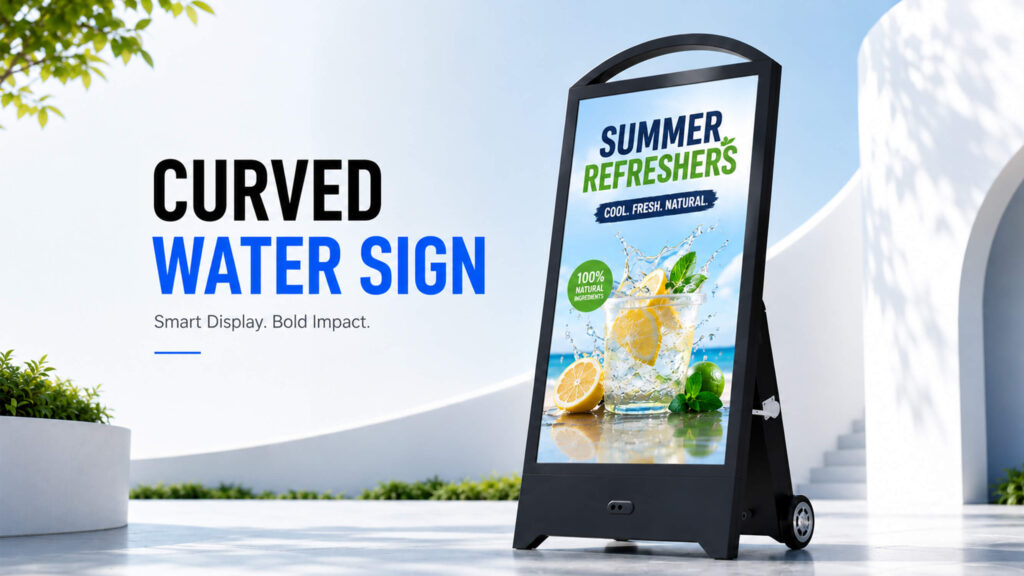
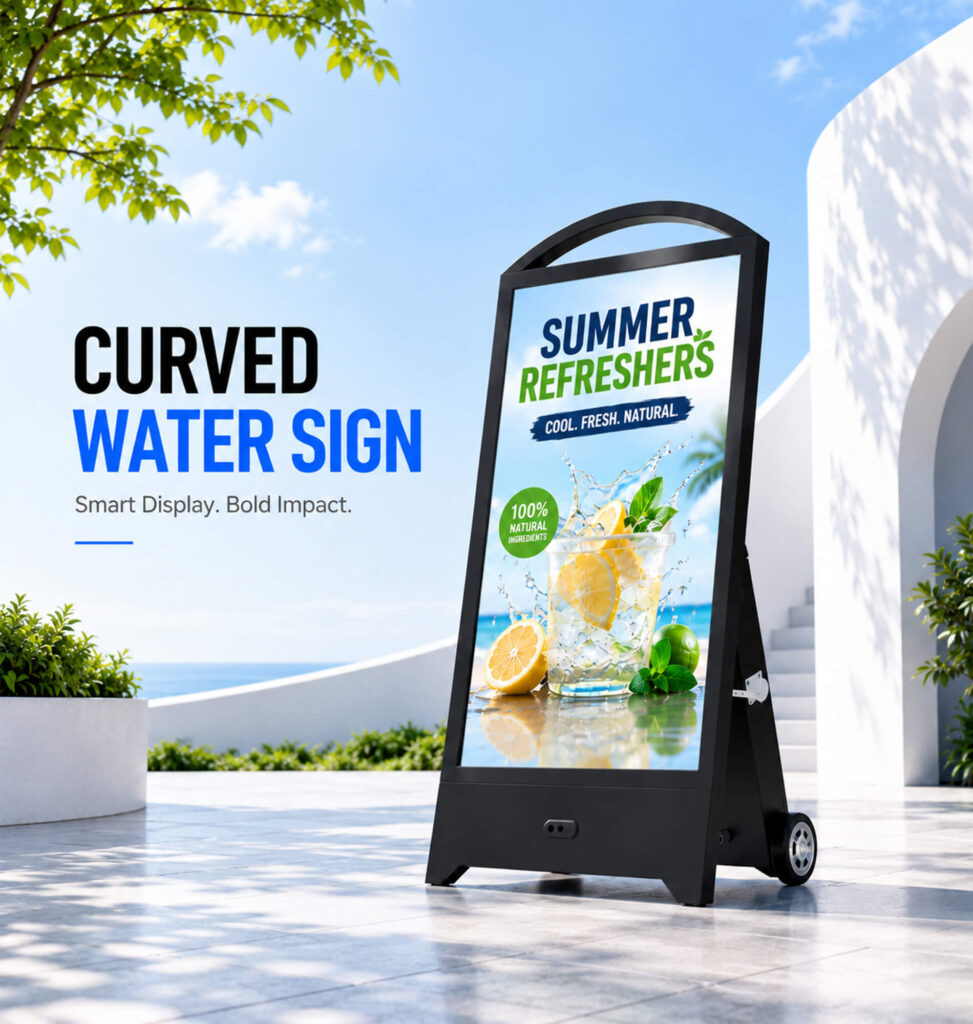
- Portable digital signage — also described as freestanding digital signage or exterior digital signage on wheels — runs on an internal battery pack, sits on a weighted rolling base, and can be deployed or relocated without an electrician, a structural engineer, or a permit application, because it isn’t attached to the building or the ground.
Side-by-Side Comparison
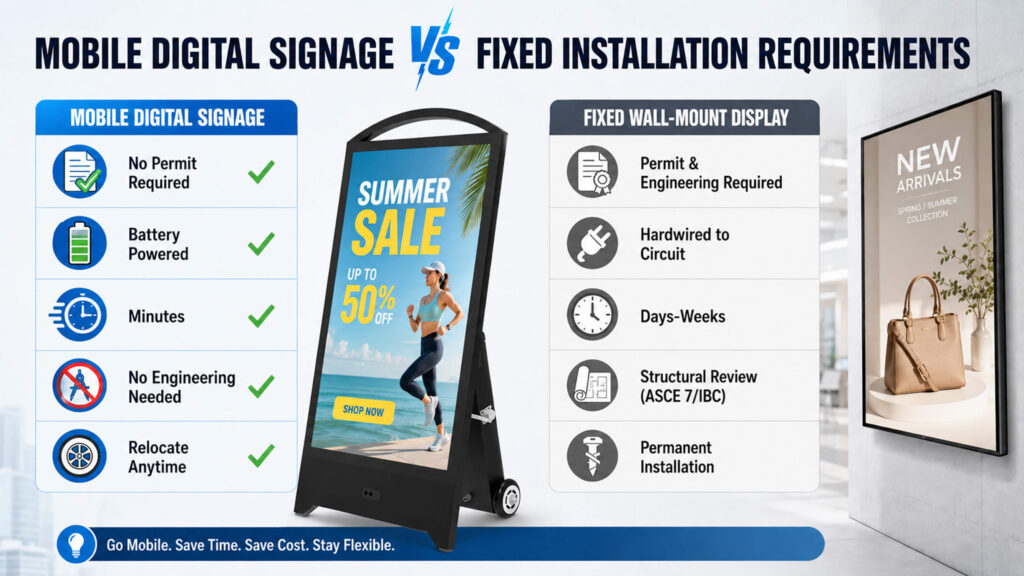
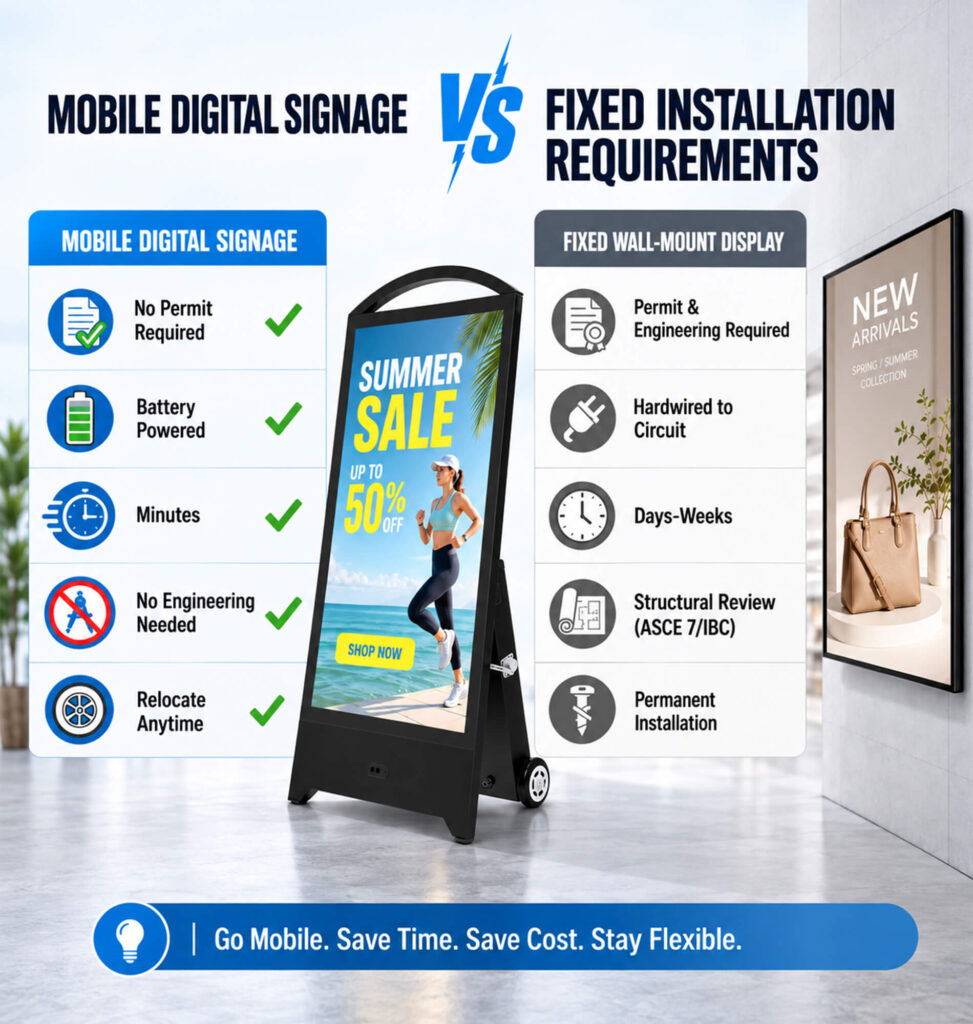
Whichever direction you’re leaning, it helps to see both formats of outdoor digital signage laid out against the same criteria:
| Factor | Portable Outdoor Signage | Fixed Outdoor Signage |
|---|---|---|
| Installation timeline | Minutes to hours — roll it into place | Days to weeks (structural review, permit, electrical rough-in, inspection) |
| Governing standards (U.S.) | UL 48 (electric sign safety), enclosure IP/NEMA rating | UL 48, NEC Article 600 (field wiring/electrical), ASCE 7 / IBC (wind load), local AHJ permit |
| Structural engineering required | No — self-contained, freestanding chassis | Often yes, for pole and canopy mounts and in high-wind or seismic zones |
| Power | Internal lithium battery, typically 8–27 hours runtime per charge depending on model | Hardwired to a dedicated, permitted electrical circuit |
| Upfront cost (43″–55″ class) | Roughly $3,000–$8,000 per unit, hardware only | Roughly $8,000–$,30,000+ per install once structural, electrical, and permit costs are included |
| Enclosure rating typically specified | IP65 or NEMA 4 (dust-tight, protected against water jets and wind-blown particles) | IP65–IP66, often paired with UL-listed cabinet certification |
| Mobility | Reposition or relocate anytime, no re-permitting | Permanent for the life of the mount |
| Best lease fit | Short-term, seasonal, or landlord-restricted sites | Long-term leases or owned real estate |
| Duty-cycle / lifespan driver | Battery: typically 500–1,500 full charge cycles before noticeable capacity loss (roughly 3–5 years of daily use); panel and chassis can outlast the battery | Commercial-grade outdoor panels are commonly rated for 50,000–70,000 hours of backlight life (7–10+ years at extended daily runtime) |
| Content use case | Promotions, events, pop-ups, seasonal campaigns, evacuation/crowd-direction points | Always-on brand presence, wayfinding, core menu/pricing, drive-thru confirmation |
(The cost range is an industry estimate; for actual pricing, please refer to the yinglux product line price list or specific supplier quotations.)
However you weigh the tradeoffs, both remain legitimate outdoor digital signage investments — the right pick depends entirely on the site, not on one format being categorically better than the other.
The Engineering Reality Behind a Fixed Installation
Buyers often underestimate what “fixed” actually commits them to when purchasing outdoor digital signage, because the display itself looks like a simple hardware purchase. It isn’t. A pole- or wall-mounted exterior display is a wind-loaded structure, and code treats it that way.
Wind load is not a rounding error.
A 55″ outdoor panel exposed to roughly 120 km/h (75 mph) wind can experience on the order of 100 kg (roughly 220 lbs) of lateral force against its mount. A 55-inch display in 120 km/h wind experiences approximately 100 kg of lateral force, which is why wind load calculations are essential for exposed locations, floor stands need substantial bases to prevent tipping, and a 55-inch display typically needs a minimum base weight of around 40 kg if it isn’t bolted directly to an existing slab. For pole-mounted or canopy-mounted units, that load has to be resolved through an engineered footing — often specified at a minimum of roughly 600mm × 600mm × 600mm and deeper in frost zones — not just a bracket and a prayer. For freestanding poles, a minimum concrete footing on the order of 600×600×600 mm is typically specified, going deeper in frost zones, and mounting on hollow walls such as residential stucco or wood-frame construction generally cannot support an outdoor display.
Code compliance isn’t optional paperwork — it’s what keeps the sign legally operable.
In the U.S., electric signs (including LED and LCD digital signage) are commonly evaluated against UL 48, and Article 600 of the National Electrical Code governs the wiring, conductors, and field installation of the sign. NEC Article 600 and UL 48 are the two standards used to evaluate the installation, conductors, equipment, and field wiring of electric signs. Structural bracing and anchorage for the mount itself is separately expected to meet seismic and wind requirements under the applicable building code — commonly the IBC referencing ASCE 7 — which is why larger or exposed installations frequently require an engineer’s stamp before a permit is issued. Mounting is expected to meet seismic and wind requirements by designing bracing and anchorage per local code, often the IBC referencing ASCE 7, obtaining engineer stamps where required, and submitting a permit package showing loads, anchors, and bracing details.
None of this means fixed signage is a bad choice — it means the eleven-week timeline in the opening scenario wasn’t a vendor being slow. It was the code-required process working as intended. Buyers evaluating a fixed installation should budget for a site survey, a stamped engineering drawing where required, and permit lead time as real line items, not an afterthought layered on top of the hardware quote.
The Power Reality Behind a Portable Unit
Portable signage’s core tradeoff is the battery, and it’s worth understanding the actual numbers rather than a marketing headline of “all-day runtime.”
Battery capacity and runtime vary meaningfully by model.
Commercial portable units on the market today typically ship with lithium-ion or lithium-polymer packs in roughly the 850–900 Wh range, delivering 8–14 hours of runtime on models optimized for daily storefront use, with some purpose-built A-frame units rated for up to 27 hours on a single charge for extended-hours or overnight display. One commercial portable signage line uses an 896Wh lithium battery delivering 10+ hours of runtime per charge, with the pack rated for roughly 1,500 charge cycles(LiFePO4) — about five years of regular use before capacity noticeably fades. Other A-frame portable displays specify up to 27 hours of runtime from a single charge, though actual runtime is based on average conditions and excludes degradation from deep cycling, overcharging, or battery sulphation over time.
Enclosure ratings matter as much as the battery.
A portable unit intended for genuine outdoor duty (not just a covered patio) should carry an IP65 rating at minimum — dust-tight and protected against low-pressure water jets from any direction — and some commercial-grade portable units are instead rated to NEMA 4, a broadly equivalent standard for protection against rain, sleet, and wind-blown dust common in North American electrical enclosure specs. One battery-powered wheeled digital signage unit is rated NEMA 4 to protect its screens from rain and windblown particles, with internal climate controls keeping components within an efficient operating temperature range. Buyers should confirm the rating applies to sustained, unsheltered outdoor exposure — some portable units are explicitly speced for temporary or sheltered outdoor use only, and using them in a fully exposed location can void the warranty and shorten real-world lifespan. Some portable outdoor-branded displays are explicitly intended for temporary or sheltered outdoor settings such as covered entryways or patios, and are not designed for long-term exposure to full sun, rain, or wind — prolonged use in fully exposed environments may cause damage and affect functionality.
What actually limits a portable unit’s working life is the battery, not the panel.
The LCD panel itself commonly carries a 50,000–70,000-hour backlight rating regardless of format, but a lithium pack’s usable capacity fades with charge cycles, so the practical replacement driver for a portable unit is battery degradation, not display failure. This is a maintenance line item fixed signage simply doesn’t have, and it should be built into any multi-year cost comparison.
When Portable Digital Signage Is the Right Call
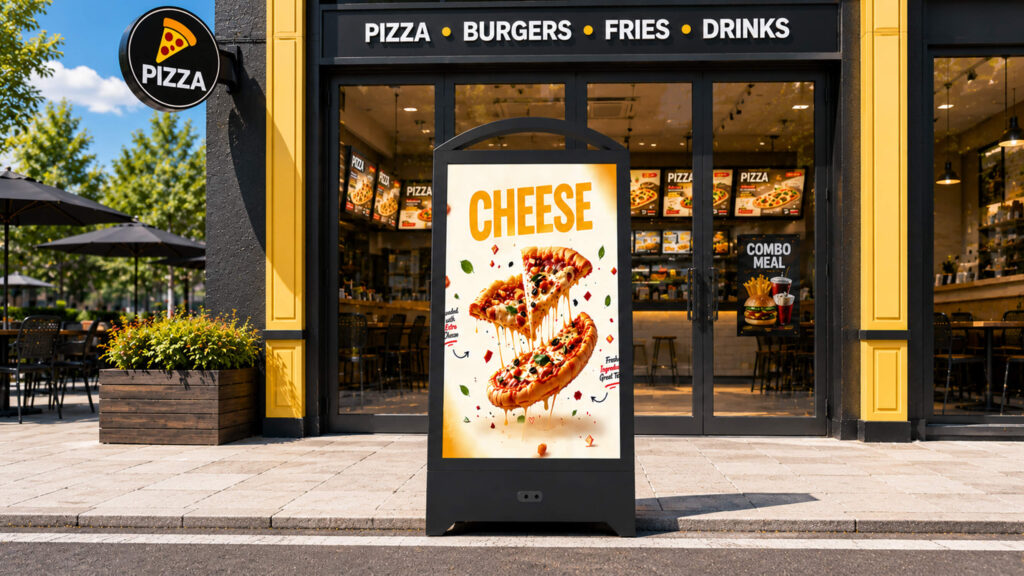
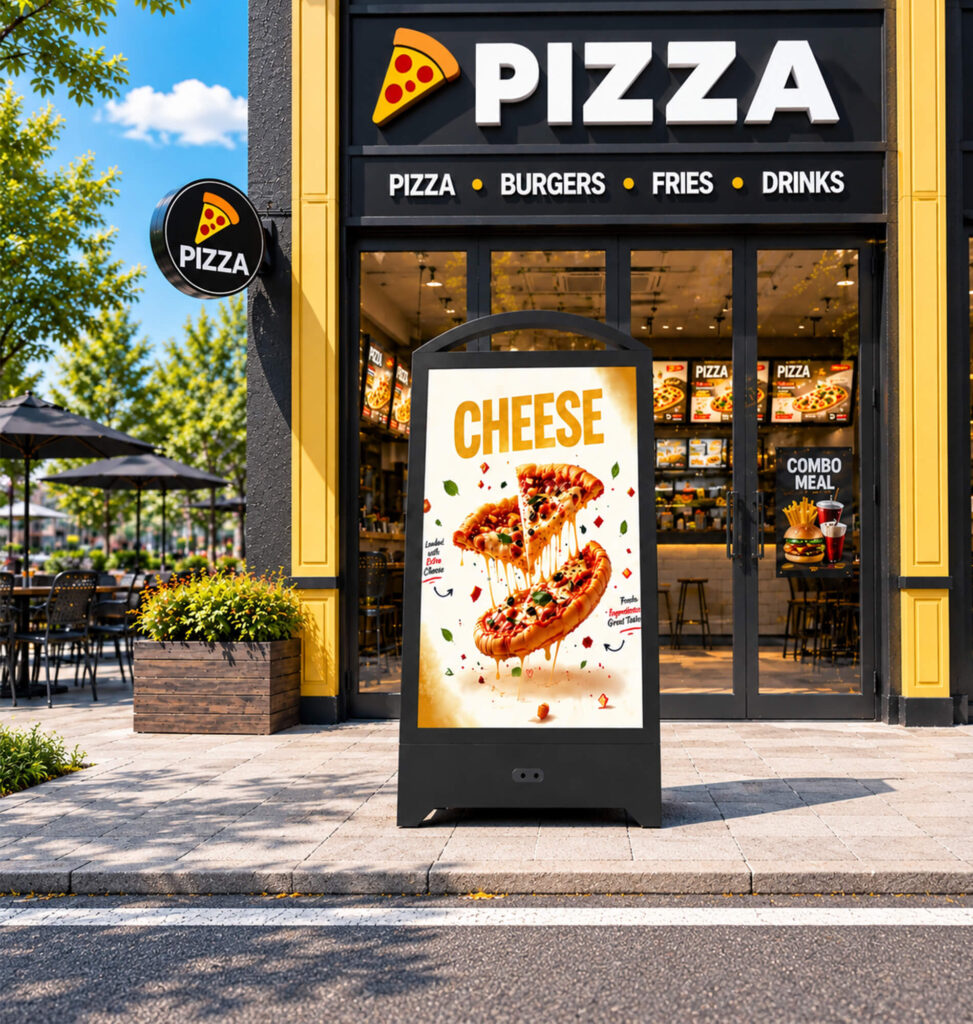
Portable outdoor digital signage units make sense whenever the site is the variable, not the message. A franchise testing a new market before committing to a multi-year lease, a chain running a six-week seasonal promotion, or a landlord who won’t sign off on exterior mounting all point toward a portable, freestanding display — because none of the UL 48/NEC 600/ASCE 7 structural and permitting obligations described above attach to a unit that isn’t fastened to the building or the ground. That’s what makes same-week deployment realistic when a grand opening is already on the calendar.
Portable digital signage also earns its keep at multi-day events, trade shows, and evacuation or crowd-direction points where a screen needs to move with the layout of the day rather than stay bolted to one spot. (For a full breakdown of what portable outdoor digital signage is and how it works, see our companion guide, What Is Portable Outdoor Digital Signage? A Complete Overview.)
When Fixed Outdoor Signage Is the Right Call


Fixed outdoor digital signage is the better long-term investment once a location is settled and the business wants the display to be part of the building itself — a drive-thru order confirmation screen, a permanent storefront brand statement, or wayfinding for a campus or shopping center. Because it’s hardwired rather than battery-run, a fixed unit has no charge-cycle degradation to manage, and the absence of a battery compartment generally allows larger panel sizes and higher-brightness configurations (commercial outdoor panels are commonly available from roughly 1,500 nits up to 4,000–7,500 nits for the highest ambient-light locations) — which matters for sites with heavy direct sun exposure or long viewing distances from the road.
The tradeoff is committing capital, a structural/electrical scope of work, and a permitting timeline upfront — worth it precisely because the location itself isn’t going anywhere.
A Practical Way to Decide — With the Numbers Behind It
Three questions settle most outdoor digital signage decisions quickly, and each maps directly to the technical realities above:
- Is the lease or site arrangement longer than roughly two years? Fixed signage’s cost advantage comes from amortizing a 7–10+ year hardware life and a one-time permitting cost over a long occupancy. Shorter than that, portable is almost always the safer capital decision — you’re not paying for engineering and permitting you won’t fully depreciate.
- Does the landlord or municipality restrict exterior structural changes? If yes, portable removes the UL 48/NEC 600/ASCE 7 approval chain entirely, since nothing is being structurally attached to the building.
- Will the display need to move — between locations, seasons, or events — more than once a year? If yes, portable’s mobility pays for itself quickly, since a fixed installation’s permitting and structural cost is sunk the moment it’s mounted and cannot follow the business to a new site.
A rough total-cost-of-ownership frame for outdoor digital signage buyers: for a comparable panel size, portable hardware typically runs $3,000–$8,000 with no separate installation or permit line item, while a fixed installation typically runs $8,000–$30,000+ once structural engineering, electrical work, and permit fees are included. Outdoor LED installations commonly range from roughly $15,000 to $120,000 depending on size, brightness tier, and structural complexity. Spread over a comparable operating life — roughly 3–5 years of daily battery cycling for portable versus 7–10+ years of backlight life for fixed — the annualized cost gap narrows considerably for long-term sites, which is exactly why the “longer than two years” threshold above is the right first filter rather than sticker price alone.
For the restaurant group from the opening scenario, the answer was straightforward: portable for the strip-mall location bound by the lease restriction, with a plan to revisit fixed signage once the lease renews and the structural/electrical scope becomes worth committing to. Many multi-location operators end up running both — portable units for new, seasonal, or lease-restricted sites, fixed units for flagship and long-term locations — rather than standardizing on one format across the whole footprint.
FAQ
1.Is portable outdoor digital signage as bright and weatherproof as fixed outdoor digital signage?
It can be, but it isn’t automatic. Reputable commercial-grade portable units carry the same IP65 (or NEMA 4-equivalent) weatherproof ratings and comparable brightness specs to fixed outdoor digital signage displays. The gap to watch for is scope: some portable units marketed as “outdoor” are actually rated only for temporary or sheltered exposure, not full-time unsheltered outdoor duty — always confirm the enclosure rating and the manufacturer’s stated exposure conditions before assuming interchangeability with a fixed unit.
2.Does a fixed installation always require a permit?
In most U.S. jurisdictions, yes, for any exterior electric sign wired to building power and/or structurally mounted — permitting is typically triggered by the electrical work (NEC Article 600) and, for pole or canopy mounts, by the structural attachment itself (evaluated against wind load under ASCE 7/IBC). Requirements vary by municipality and by whether the mount is wall, pole, or canopy, so a site-specific permit check is still necessary — but assuming “no permit needed” for a hardwired exterior sign is the most common planning mistake buyers make.
3.Can a portable display later be converted to a fixed installation?
Not directly. The two use different chassis, power systems, and enclosure designs — a fixed unit typically has no battery compartment or castors, and a portable unit isn’t built with the structural mounting points a stamped engineering drawing would specify. A business planning to eventually go fixed should budget for a separate fixed unit rather than expecting to convert the portable one.
4.Which option has a lower total cost of ownership?
It depends on the time horizon and site permanence, not just the upfront quote. Portable signage has a lower and simpler upfront cost (no engineering or permit line items) but a shorter practical lifespan driven by battery degradation — typically 500–1,500 charge cycles, or roughly 3–5 years of daily use. Fixed signage costs substantially more to install once structural and electrical work is included, but amortizes over 7–10+ years of panel life with no battery to replace, which typically makes it the lower annualized cost for a genuinely permanent, long-term location.
5.What enclosure rating should I actually ask for on outdoor digital signage?
For unsheltered, full-time outdoor exposure, ask for IP65 or higher (IP66 for higher-dust or coastal environments), or the NEMA 4 equivalent if the vendor specs to NEMA rather than IP. Also ask specifically whether the rating applies to continuous, fully exposed outdoor use or only to sheltered/temporary outdoor placement — the two are not the same claim, even when both are marketed as “outdoor.”
6.Do I need different outdoor digital signage for different climates?
Yes, in practice. Coastal or high-humidity sites benefit from a higher dust/salt-spray protection tier (IP66) and corrosion-resistant hardware; cold-climate sites should confirm the unit’s rated operating temperature range and any built-in heating element, since battery performance and LCD response times both degrade in sustained sub-freezing conditions — a spec worth confirming for portable units in particular, since they can’t rely on building HVAC the way some fixed installations can.
Next Steps for Your Business
Not sure which outdoor digital signage format fits your next location? Compare the full portable lineup or get a fixed-signage recommendation from our team.
- Exploring portable options → [Portable Outdoor Digital Signage ]
- Not sure yet? → [Request a quote / talk to our team]