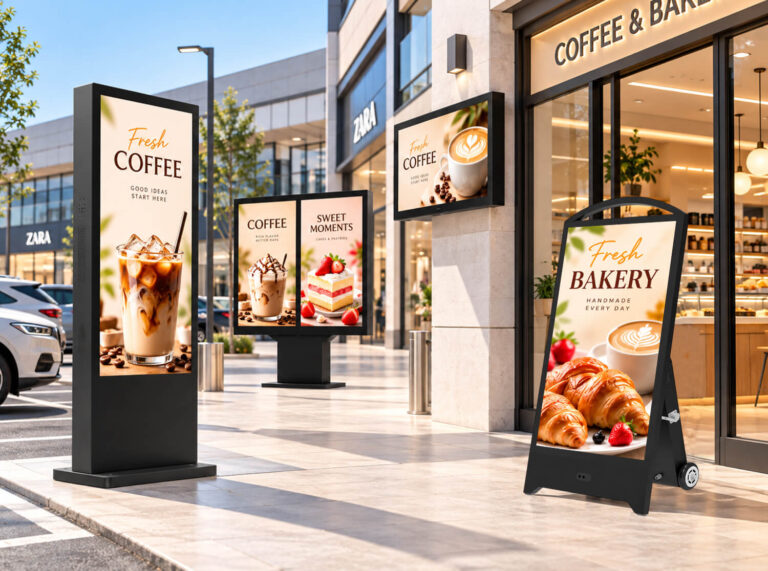
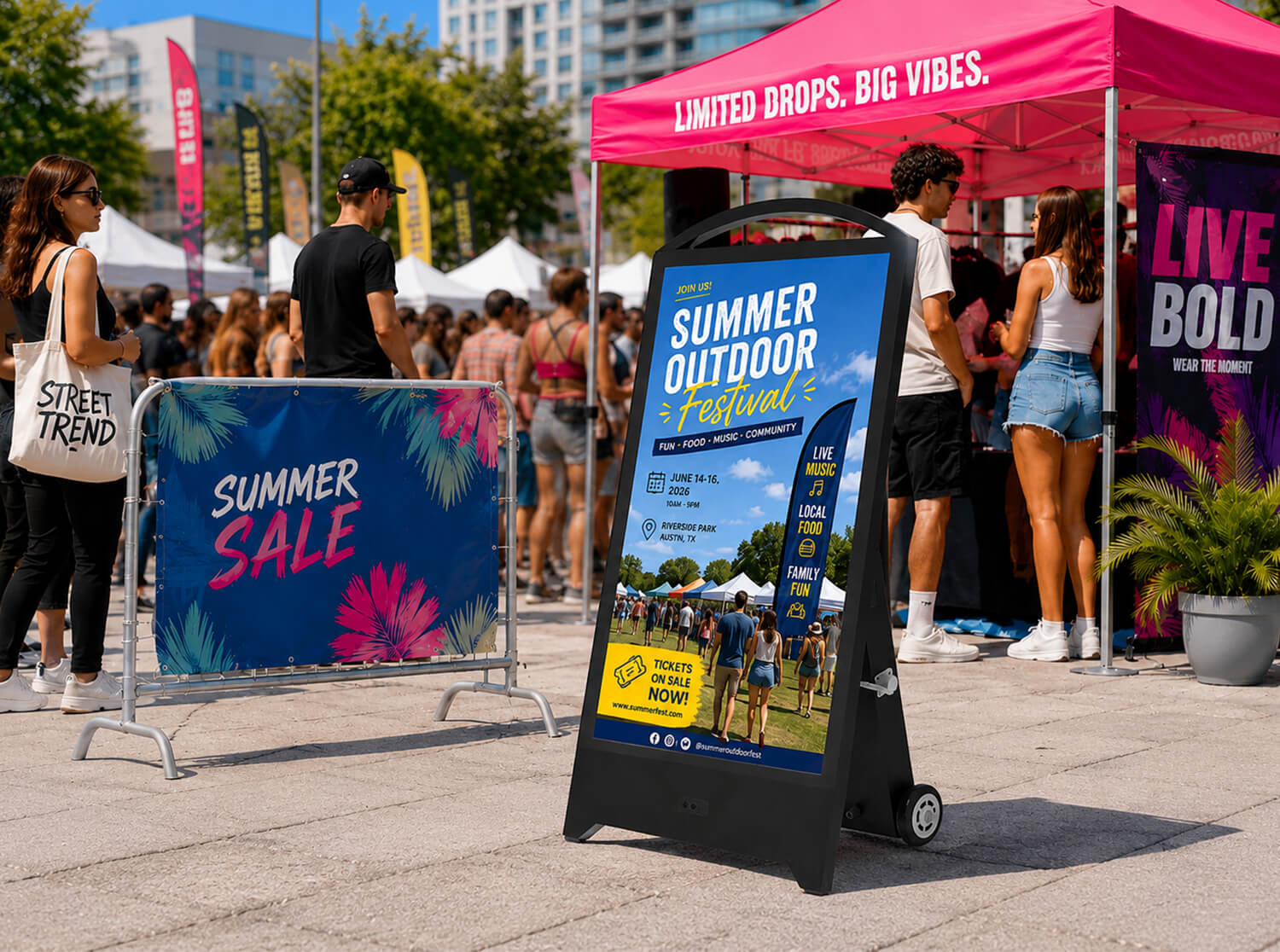
It’s Friday afternoon, and the operations manager of a regional furniture chain is loading a folding table, a stack of printed banners, and a hand-lettered “50% OFF THIS WEEKEND ONLY” sign into a van. The pop-up sale runs in a parking lot two towns over — no storefront, no power outlet nearby, and three days before the lot is leased to someone else next week.
By Saturday noon, the banner has washed out under direct sun and the corners are curling in the heat. Sunday afternoon it rains, and the sign is a soggy write-off. Monday, the same team is back at the office printing a replacement for next weekend’s location, because the promotion changes and the banner has to be reprinted every time.
This is the standard operating reality for any business running temporary or rotating locations — pop-up retail, seasonal lots, festival booths, franchise openings, dealership overflow lots. The location isn’t fixed, the message changes weekly, and the outdoor environment actively degrades whatever’s printed on paper. It’s also, increasingly, a measurable revenue problem: industry research aggregating ad-recall studies from 2017–2022 found that out-of-home advertising produces significantly higher consumer recall than television, streaming, podcasts, radio, print, and online formats, and that advantage holds specifically for digital out-of-home (DOOH) formats. A sign that’s illegible by noon or ruined by Sunday’s rain isn’t just an inconvenience — it’s forfeiting a channel that outperforms the alternatives it’s competing against, provided it’s actually visible and running.
This is the operational gap portable outdoor digital signage is built to close.
What It Actually Is
A portable outdoor digital sign is a self-contained digital display — typically housed in a wheeled cabinet or mounted on a lightweight stand — sealed against weather and designed to relocate without a fixed installation or specialized crew. It occupies the middle ground between a folding sandwich board and a permanently mounted LED billboard: the brightness and real-time content control of a digital screen, with the physical portability of equipment that rolls out of a van in minutes.
Within this category, the terminology varies slightly depending on who’s buying and why. Retailers and event planners often search for mobile digital signage when the emphasis is on frequent relocation — a unit that travels between sites on a set schedule. Facilities and property teams more often use freestanding digital signage when the priority is a self-supporting unit that doesn’t require wall mounting or structural work, even if it isn’t moved often. And portable digital signage is the broader umbrella term covering both — any display designed to be deployed and relocated without permanent installation. The furniture chain’s use case sits squarely at the intersection of all three: a unit that’s freestanding at each site, moved weekly, and portable enough for a two-person crew to handle without specialized equipment.
For the furniture chain, that means one physical unit follows the promotion from lot to lot, and when the offer changes from “50% off sofas” to “clearance on floor models,” the update happens from a laptop at the regional office — no reprint, no drive-out, no lag between the pricing decision and what’s on display. That flexibility to update creative in real time is precisely the mechanism analysts point to when they identify DOOH as a distinct, faster-response category within the broader digital signage market — one growing meaningfully faster than static formats.
The Market Context: Why Portable Outdoor Digital Signage Is Expanding
This isn’t a niche shift. Multiple independent research firms converge on similar figures for how fast outdoor digital deployment is scaling. Grand View Research valued the global digital signage market at USD 31.1 billion in 2025, projecting growth to USD 33.6 billion in 2026 and USD 58.4 billion by 2033. Within the U.S. specifically, Mordor Intelligence reports the market at USD 9.73 billion in 2026, reaching USD 13.81 billion by 2031, and notes that while indoor deployments represented roughly 78% of 2025 revenue, outdoor installations are projected to grow at an 11.95% compound annual rate — nearly double the pace of the indoor segment. Separately, industry trade coverage estimates the outdoor digital signage (DOOH) segment specifically at USD 9–12 billion in 2025, rising toward USD 15–20 billion by 2030, with outdoor’s share of total digital signage spend trending toward 30–40% of the category overall.
The practical takeaway for a procurement decision-maker: outdoor digital deployment isn’t a speculative bet on emerging technology. It’s the fastest-growing segment of an already large and well-established market, and the growth is concentrated specifically in the use case — locations without fixed infrastructure — that portable units serve.
Why “Outdoor-Rated” Actually Matters for Portable Outdoor Digital Signage (and Where Buyers Get Burned)
A common and costly mistake: buying a screen marketed as “high brightness,” assuming that covers outdoor readiness, and discovering the gap on the first rainy weekend. Brightness and weatherproofing are two independent specifications solving two different failure modes, and a unit needs to satisfy both — not one used as a proxy for the other.
Brightness solves the sun problem.
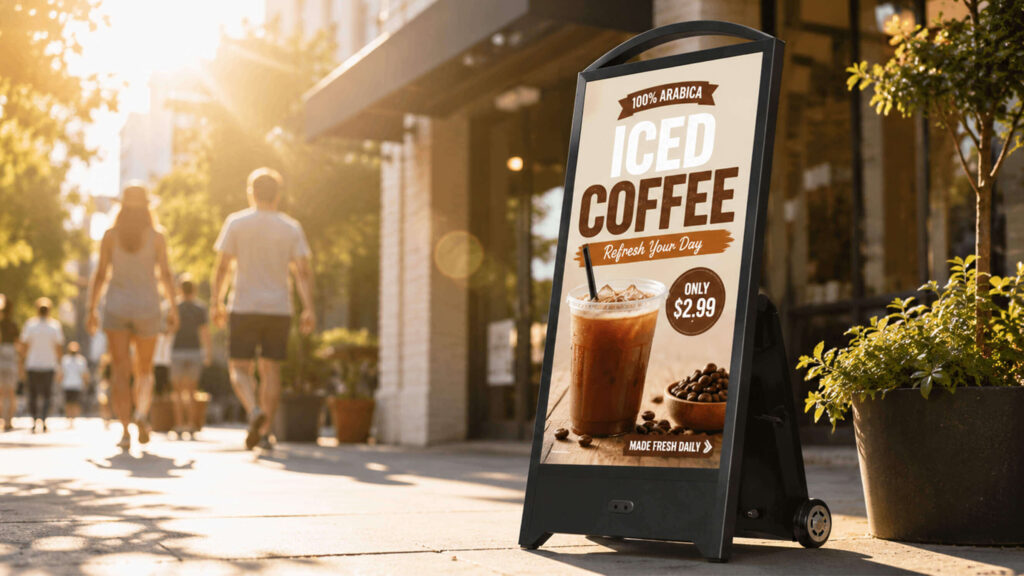
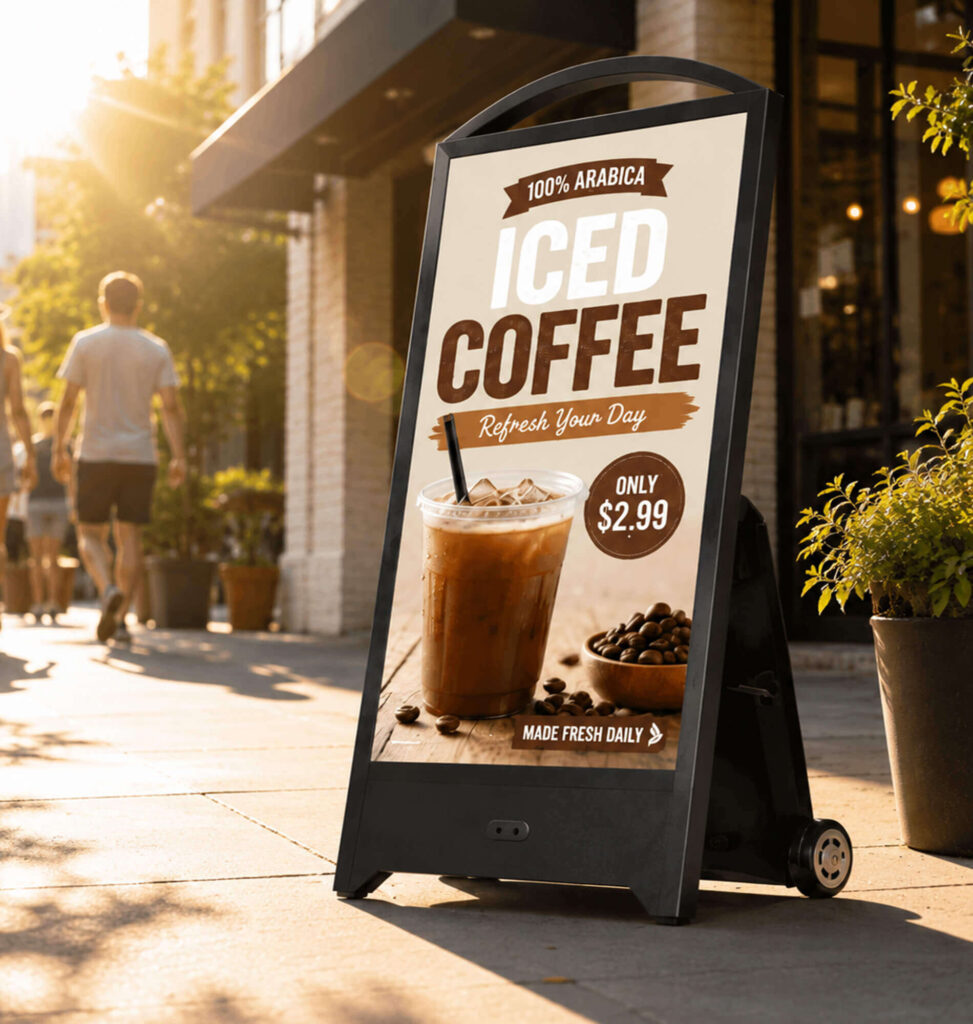
A typical indoor commercial screen runs 400–700 nits, sufficient indoors but functionally unreadable in direct sunlight. Outdoor-rated units are generally specified at 1,000–3,500 nits — roughly 5 times brighter — which is the difference between the chain’s sign being legible from the road at 1 p.m. versus reading as a dark rectangle from fifty feet away.
Weatherproofing solves the rain-and-dust problem, governed by a separate standard entirely.
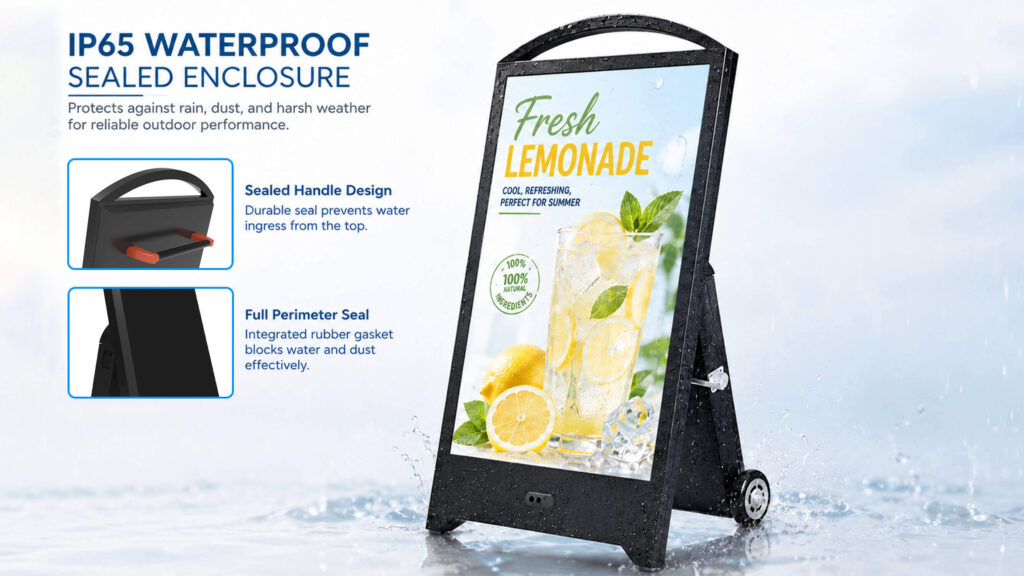
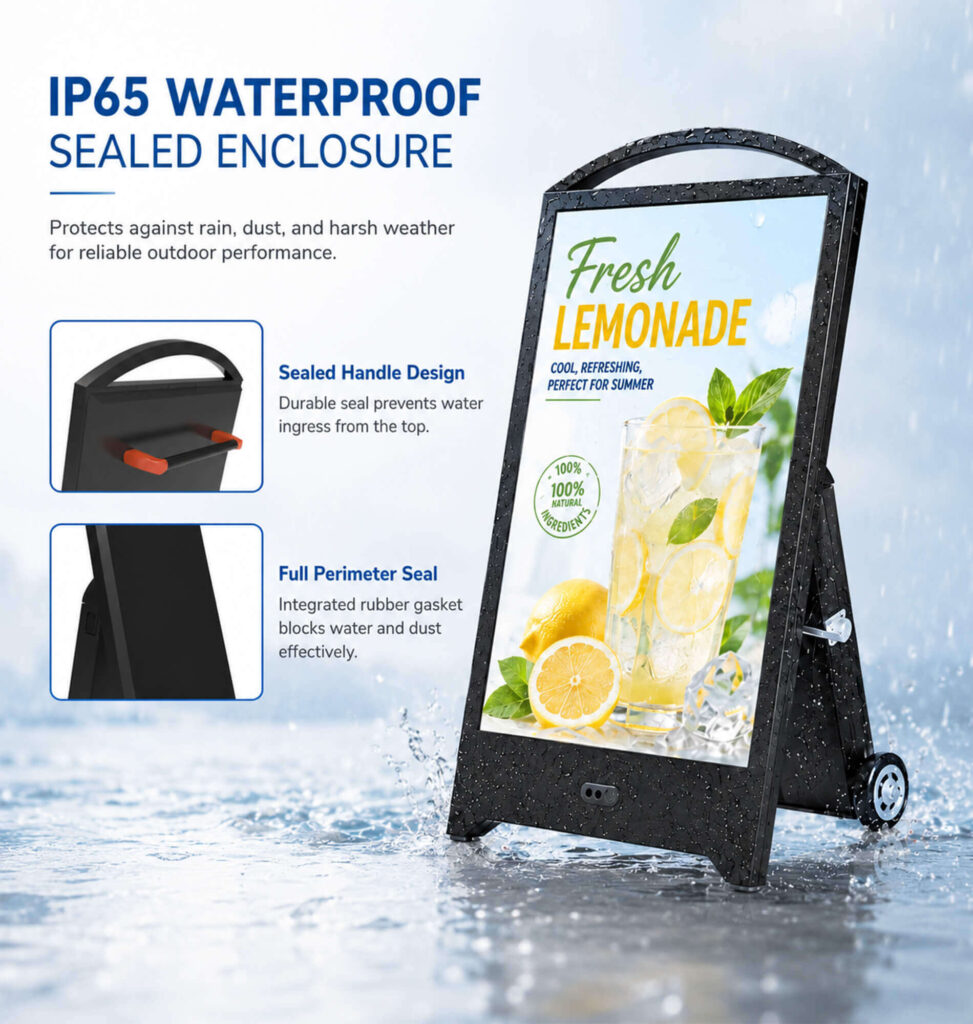
The relevant reference is the IP (Ingress Protection) rating system defined under IEC 60529, an internationally recognized standard for how well an enclosure resists solid particles and liquid ingress — not a marketing adjective. A unit rated IP65 or higher is dust-tight and protected against low-pressure water jets from any direction, which covers ordinary rain exposure. A screen can be extremely bright and still fail in a rainstorm if the enclosure isn’t sealed to this standard, so buyers should confirm the IP rating on the spec sheet independently of any brightness claim, rather than inferring one from the other.
For the furniture chain’s Sunday-rain scenario specifically: a properly IP-rated unit doesn’t need to come inside every time clouds roll in — which changes the underlying cost-benefit case for switching off print in the first place.
How Portable Outdoor Digital Signage Is Powered and Moved
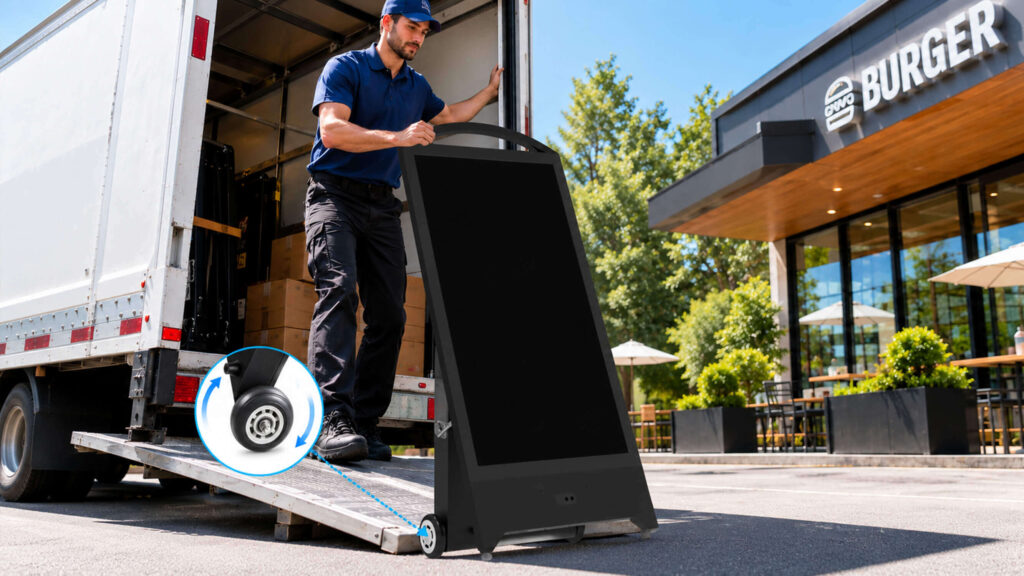
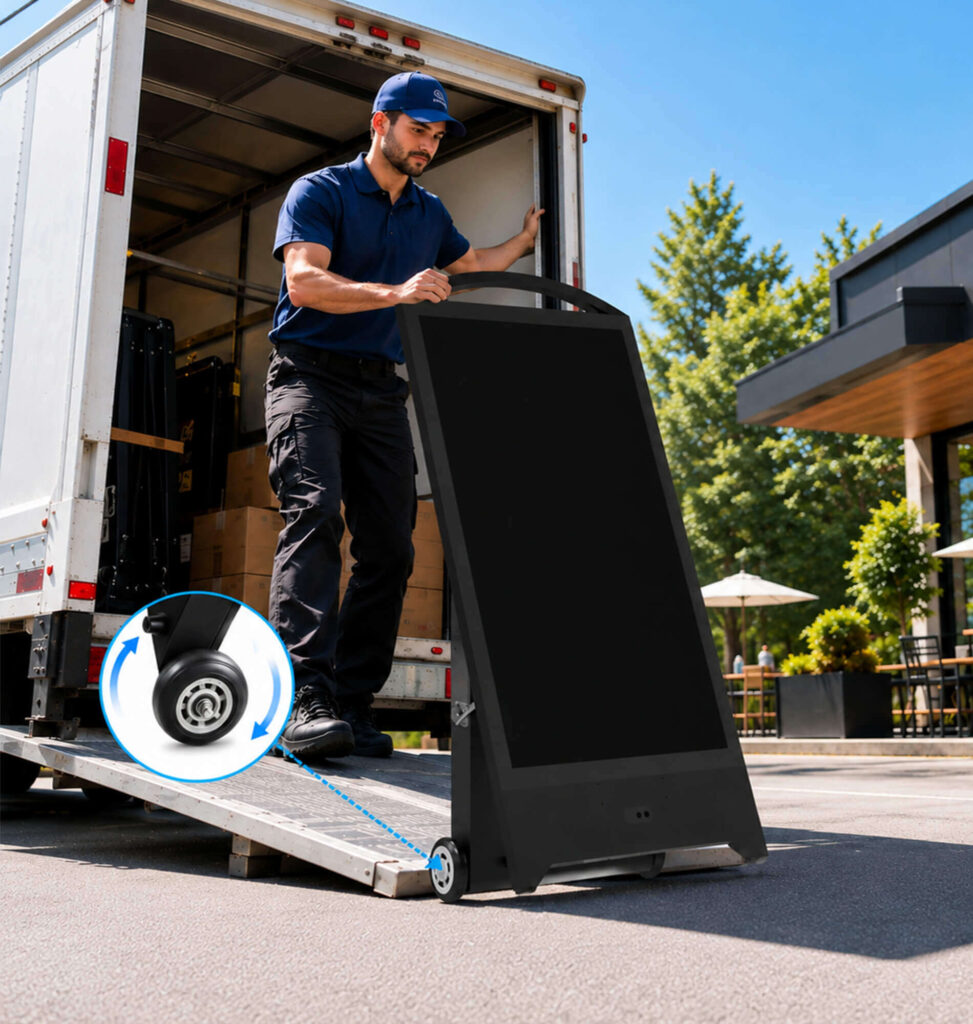
The question that comes up immediately in B2B procurement conversations: “our pop-up locations don’t always have power access — does that rule this out?” It doesn’t, and it’s one of the category’s core design features.
Most portable outdoor units ship in two configurations:
- Battery-powered units, with an integrated pack typically rated for 8–12 hours per charge, built for locations with no outlet access — a parking lot sale, a festival field, a construction perimeter.
- Plug-in units, for locations with standard power access but where permanent electrical work isn’t practical or approved.
Mobility follows a similar split. Larger units (55 inches and up) typically use locking caster wheels, letting one or two people move the unit off a van ramp and secure it without tools. Smaller units often use a tripod or telescoping pole stand — lighter and faster to deploy for a single staff member working alone.
Content is managed through a cloud-based CMS over WiFi or 4G/LTE, so the person scheduling next weekend’s promotion doesn’t need to be at the physical location to do it. For the furniture chain, that means the regional manager updates pricing across three pop-up sites from one laptop the same afternoon a new promotion is approved — a workflow advantage that maps directly onto why real-time creative control is cited as a structural advantage of DOOH over static formats in comparative advertising-effectiveness research.
Portable Digital vs. the Alternatives
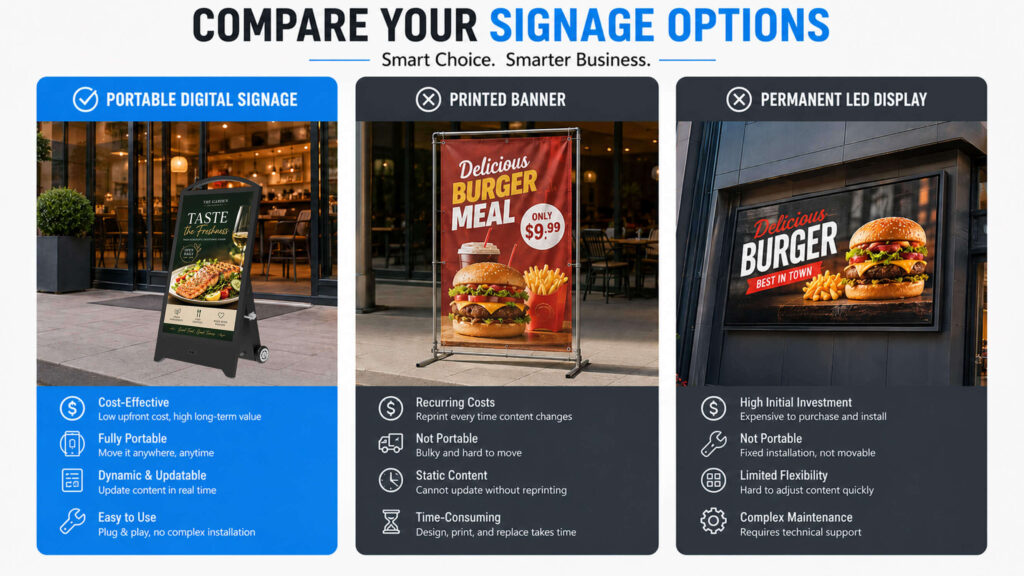
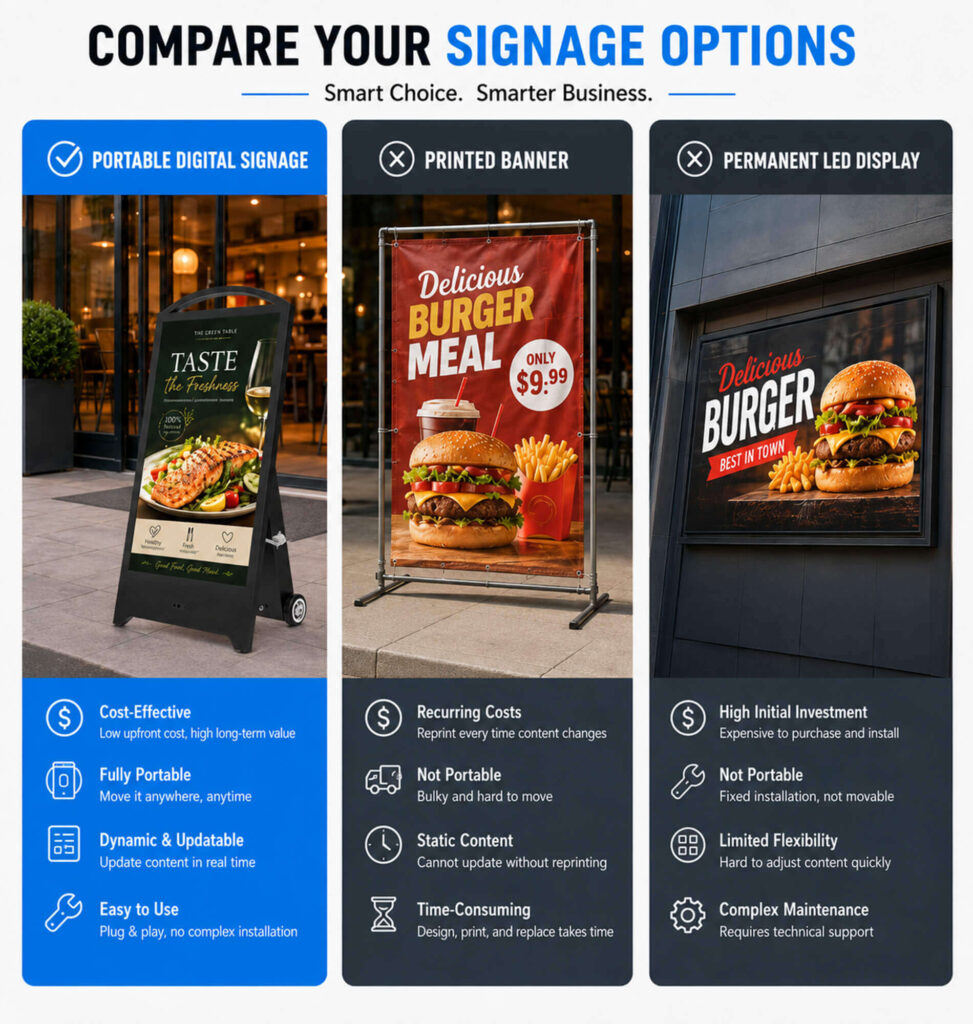
| Comparison Metric | Portable Outdoor Digital Signage | Static Printed Signage | Permanent Outdoor LED Display |
|---|---|---|---|
| Setup time | Minutes, no tools | Minutes | Days to weeks (permitting, mounting) |
| Content updates | Remote, same-day | Reprint required every change | Remote, same-day |
| Moves with the business | Yes — designed for it | Technically, but appears improvised | No — fixed installation |
| Weather resistance | High (IP65+) | Degrades quickly outdoors | High |
| Upfront cost | Moderate | Low, but recurring reprint costs accumulate | High |
| Best fit | Locations or messaging that change | One-time, short-duration, low-budget needs | A flagship storefront that isn’t relocating |
The honest calculation for a business like the furniture chain: printed signage is cheaper per unit, but reprint costs and weather-loss cycles compound quickly across a multi-weekend campaign. A permanent LED display solves visibility but assumes a location that isn’t moving — which defeats the purpose for pop-up or rotating operations entirely.
Before You Buy Portable Outdoor Digital Signage: What to Verify
For the person signing off on this purchase, these are the checks that separate a unit that performs from one that becomes a liability by month two:
- Confirm brightness of 3,000+ nits for any location with direct sun exposure — don’t take “outdoor-rated” at face value.
- Confirm the IP rating independently, from the spec sheet, referencing IEC 60529 — IP65 or higher for genuine weather exposure.
- Match battery runtime to the actual deployment window — an 8-hour battery underperforms if the booth runs 10 hours a day.
- Size the screen to realistic viewing distance — a general benchmark is roughly 10 feet of distance per inch of diagonal size for text-heavy content.
- Confirm the CMS fits the team’s actual workflow — cloud-based scheduling matters more when content is managed centrally across multiple sites.
- Be realistic about who’s moving it — verify weight and wheelbase against the actual transport method, not an idealized one.
- Ask about warranty terms specific to outdoor use — these units absorb more environmental wear than indoor equivalents, and coverage should reflect that.
Frequently Asked Questions
Is portable outdoor digital signage actually waterproof?
Units rated IP65 or higher under IEC 60529 are dust-tight and resist water jets from any direction, covering normal rain exposure. Full submersion resistance (IP67/68) isn’t standard or necessary for this category.
How bright does it need to be to read in direct sunlight?
Generally 4,000 nits or higher. Below that threshold, content becomes difficult to read at midday even where it appears fine at dusk or under cloud cover.
Can it run without access to a power outlet?
Yes — battery-powered units are standard in this category and typically run 8–12 hours per charge, though video content draws more power than static images and shortens runtime.
Does digital out-of-home actually outperform static signage, or is that just a sales claim?
Independent research supports it. Aggregated advertising-effectiveness studies published through the Out of Home Advertising Association of America found that out-of-home formats produce higher ad recall than television, streaming, podcasts, radio, print, and online advertising, and a Harris Poll survey commissioned by the same association found that 73% of consumers view DOOH ads favorably and 76% of recent DOOH viewers reported taking action after seeing one. These are third-party studies, not vendor marketing claims.
What does portable outdoor digital signage typically cost?
Pricing varies by screen size, brightness rating, and battery capacity. Smaller units start in the low thousands (USD); larger, high-brightness, extended-battery units run considerably higher. A quote based on specific size and use case is the most accurate way to budget.
Is it durable enough for weekly deployment, not just occasional events?
Units built to commercial outdoor specifications — IP65+, reinforced or aluminum enclosures — are engineered for regular deployment rather than one-off use. The IP rating and enclosure material are the relevant durability signals, not price alone.
What’s the difference between mobile digital signage and freestanding digital signage?
The terms overlap but emphasize different things. Mobile digital signage highlights frequent relocation — the unit is expected to move between sites regularly. Freestanding digital signage highlights self-support — the unit doesn’t require wall mounting or structural installation, regardless of how often it’s moved. Portable digital signage is the broader category that covers both. Most portable outdoor units are designed to satisfy all three definitions at once.
Curious whether portable outdoor digital signage fits your specific locations and rotation schedule? [Talk to us about the right size and setup →] (https://yinglux.com/outdoor-portable-digital-signage/)